Machinery and Equipment
 Pharmaceutical
 Automobile and Transportation
 Chemical & Materials
 Medical Devices
 Consumer Goods
 Semiconductor and Electronics
 Technology and Media
 Food and Beverages
 Energy and Mining
 Agriculture
 Biotechnology
 Construction
 Defense and Aeronautics
 Entertainment
 Retail
 Travel & Leisure
 Metals and Minerals
 Healthcare IT
 Oil & Gas
 Robotics & Automation
 Banking, Financial Services and Insurance (BFSI)

Key Market Insights
The Global supply chain management [SCM] market was valued at US$ 23.4 billion in 2024 and is on track to approach US$ 63.77 billion by 2032, expanding at an 11.45% CAGR during the forecast period. This robust market growth is powered by three converging forces: a post‑pandemic push for end‑to‑end visibility, rapid cloud adoption that collapses IT overhead, and a surge of AI‑driven analytics that turns raw logistics data into real‑time decisions. First‑hand industry insights confirm that supply‑chain disruptions of recent years have moved SCM from “nice‑to‑have” to board‑level priority. A SAC Insight evaluation also shows accelerating software refresh cycles as firms replace legacy ERP bolt‑ons with modern, modular platforms. The U.S. SCM market is projected to exceed US$ 18 billion by 2032, reflecting the country’s outsized logistics spend and appetite for predictive planning tools.
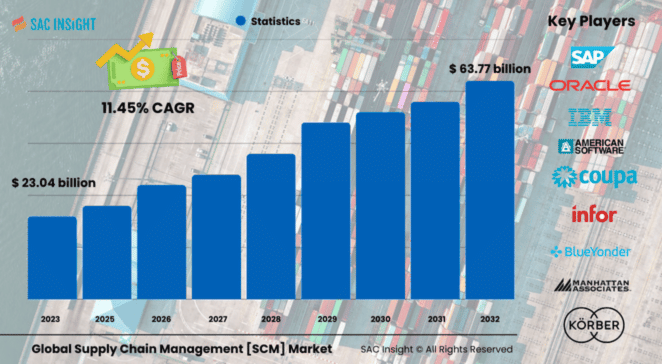
Summary of Market Trends & Drivers
• AI‑enabled demand sensing, autonomous planning, and control‑tower dashboards are now baseline requirements rather than pilot projects.
• Near‑shoring and vendor diversification are rewriting network design rules, driving fresh demand for scenario modeling and risk analytics. Cloud‑first deployments dominate new contracts as CIOs chase faster upgrades and lower capital outlay.
Key Market Players
The supply chain management market report profiles established heavyweights and fast‑scaling specialists alike. Global leaders such as SAP, Oracle, Blue Yonder, and Infor set the competitive tempo with frequent feature releases and ecosystem partnerships. Meanwhile, innovators like Kinaxis, o9 Solutions, and Manhattan Associates carve out share through AI‑rich micro‑services and industry‑specific accelerators. Together, these firms are reshaping how organizations orchestrate planning, sourcing, production, and last‑mile delivery.
Key Takeaways
• Market size (2024): ~USD$ 23.4 billion
• Projected value (2032): ~USD$ 63.77 billion at an 11.45% CAGR
• Cloud deployments already account for over 50% of new licenses, the fastest‑growing delivery model.
• Transportation Management Systems (TMS) remain the largest single module, while Inventory & Warehouse Management is the quickest to scale in e‑commerce‑heavy regions.
• North America holds roughly 35.85% market share, but Asia‑Pacific is the clear growth engine with a forecast 14% CAGR.
• M&A activity is high as vendors bundle planning, execution, and risk modules into unified suites.
Market Dynamics
Drivers
• Demand for real‑time, data‑driven decision‑making across multi‑tier supply networks
• Proliferation of cloud and edge computing that lowers integration barriers
• Rise of e‑commerce and just‑in‑time delivery expectations pushing digital fulfillment tools
Restraints
• Cyber‑security and data‑sovereignty concerns slowing rollouts in certain jurisdictions
• Skills gap in advanced analytics and change‑management disciplines
• Fragmented IT landscapes in developing economies limiting full‑stack adoption
Opportunities
• Generative‑AI copilots that automate root‑cause analysis and scenario planning
• Green‑supply‑chain mandates opening niches for carbon‑tracking and circular‑economy modules
• Mid‑market and SME segments seeking subscription‑priced, plug‑and‑play solutions
Challenges
• Regulatory divergence (trade tariffs, ESG disclosure rules) complicating global standardization
• High availability of substitute point solutions creating pricing pressure
• Complex change‑management needs as organizations migrate from on‑premise to cloud
Regional Analysis
North America commands the largest revenue slice thanks to early technology adoption and heavy logistics expenditure, while Asia‑Pacific is set to post the fastest gains as manufacturing shifts east and cross-border e‑commerce booms. Europe prioritizes sustainability compliance, Latin America focuses on cost‑to‑serve reduction, and the Middle East & Africa leverages strategic trade‑lane positioning.
• North America: mature user base, strong focus on AI‑driven visibility
• Europe: sustainability and supply‑chain‑law compliance drive upgrades
• Asia‑Pacific: double‑digit expansion fueled by manufacturing and online retail
• Latin America: cost optimization and last‑mile innovation lead demand
• Middle East & Africa: logistics‑hub investments and free‑trade zones spur adoption
Segmentation Analysis
By Component
• Solutions – 55.1% share. Core modules include TMS, Planning & Analytics, Warehouse & Inventory, Procurement & Sourcing, and Manufacturing Execution.
These solutions automate order processing, cut excess inventory, and provide the visibility executives need to fine‑tune capacity and working capital.
• Services – fastest‑growing sub‑segment.
Professional and managed services deliver data‑driven diagnostics, predictive cost modeling, and continuous improvement programs that keep platforms current and responsive.
By Deployment
• On‑Premise – legacy stronghold, ~49% share. Favored by asset‑heavy industries with stringent data controls.
• Cloud – CAGR above 14%. Offers elastic compute, lower upfront costs, and seamless upgrades, making it the go‑to choice for new implementations.
By Enterprise Size
• Large Enterprises – 47% share.
Require advanced shipment notifications, in‑transit dashboards, and multi‑site orchestration to manage global complexity.
• SMEs – highest CAGR (~12%).
Attracted to subscription pricing and QuickStart bundles that boost fulfillment accuracy without heavy IT lift.
By Industry
• Manufacturing – 20% share.
Automation and predictive maintenance cut downtime and shrink total cost of ownership.
• Retail & E‑commerce – CAGR 14%.
Real‑time inventory and last‑mile optimization are mission‑critical for customer satisfaction.
• Automotive, Healthcare, F&B, Transportation & Logistics each bring unique compliance and traceability needs, creating steady demand for configurable workflows.
Industry Developments & Recent Market Moves
• Feb 2024: Blue Yonder acquires a planning‑software specialist to bolster automotive offerings.
• Dec 2023: Oracle rolls out AI‑powered rebate and usage‑based pricing features inside its cloud SCM suite.
• Aug 2023: o9 Solutions partners with a state government to launch a supply‑chain skills academy, expanding talent pipelines.
• May 2023: A global consultancy deepens its alliance with a leading SCM vendor to co‑develop control‑tower blueprints that cut response time by 30%.
• Apr 2023: A major ERP provider embeds generative‑AI assistants for quote‑to‑cash automation across its manufacturing cloud.
Facts & Figures
• Over 35% of enterprises now run an integrated TMS to trim freight spend by up to 8%.
• Cloud deployments cut total cost of ownership by roughly 25% compared with on‑premise setups.
• AI‑enabled demand sensing improves forecast accuracy by 30‑40% during volatile cycles.
• Real‑time visibility tools can reduce inventory carrying costs by 10‑12%.
• M&A deals in the SCM software arena grew 22% year‑on‑year in 2024, signaling ongoing consolidation.
Analyst Review & Recommendations
Our latest market analysis confirms that the SCM Market is shifting from siloed optimization to holistic, AI‑assisted orchestration. Vendors that combine cloud‑native architectures with explainable analytics and strong partner ecosystems will outpace competitors. Buyers should prioritize platforms that deliver rapid time‑to‑value, robust cyber‑resilience, and a clear roadmap for sustainability reporting. With supply‑chain volatility now the norm, strategic investment in adaptive, data‑rich solutions is no longer optional—it is the surest route to resilience and profitable growth.