Machinery and Equipment
  Pharmaceutical
  Automobile and Transportation
  Chemical & Materials
  Medical Devices
  Consumer Goods
  Semiconductor and Electronics
  Technology and Media
  Food and Beverages
  Energy and Mining
  Agriculture
  Biotechnology
  Construction
  Defense and Aeronautics
  Entertainment
  Retail
  Travel & Leisure
  Metals and Minerals
  Healthcare IT
  Oil & Gas
  Robotics & Automation
  Banking & Finance
Market Overview
The global human capital management (HCM) market size was valued at US$ 29.5 billion in 2024 and is on track to reach about US$ 72.77 billion by 2032, expanding at an estimated 12.0% CAGR from 2025-2032. This market growth is propelled by three structural shifts: the mass migration from on-premise to cloud HR platforms, rapid infusion of AI into core HR workflows, and a post-pandemic surge in remote and hybrid work that demands digital-first employee experiences. First-hand industry insights confirm that organizations are funnelling record budgets into payroll automation, skills analytics, and employee-centric self-service portals. SAC Insight evaluation also shows the U.S. human capital management market alone is poised to clear US$ 24 billion by 2032 as enterprises race to modernize legacy HR stacks.
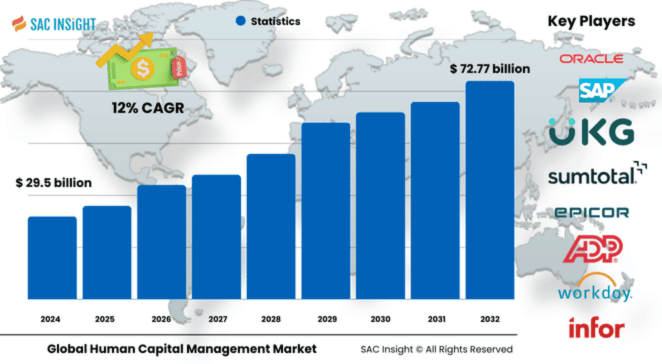
Summary of Market Trends & Drivers
• AI-driven talent acquisition, generative-AI chatbots, and predictive workforce analytics are becoming baseline requirements rather than premium add-ons.
• Cloud subscription models are widening access for mid-market firms, while large enterprises double down on multi-country payroll consolidation and compliance automation.
• Heightened focus on employee well-being and diversity, equity, and inclusion (DEI) is steering investments toward engagement apps, continuous listening tools, and data-driven pay-equity audits.
Key Market Players
Global leadership rests with a tight cohort of full-suite vendors and specialized challengers. Multinationals such as SAP, Workday, Oracle, ADP, and UKG command significant market share through end-to-end platforms that blend core HR, payroll, and analytics. Meanwhile, agile players, including Ceridian, Cegid, BambooHR, and a growing bench of AI-native start-ups, are carving out niches in generative-recruiting, continuous performance, and sector-specific HCM modules. Continuous M&A activity, particularly around AI and payroll localization, keeps competitive intensity high.
Key Takeaways
• The Global Human Capital Management (HCM) Market size (2024): USD$ 29.5 billion
• Projected value (2032): USD$ 72.77 billion at a 12% CAGR
• North America holds ≈ 41% market share, with Europe and Asia-Pacific following closely.
• Software dominates with ~67% revenue share; services post the fastest growth as firms seek implementation and managed payroll support.
• Cloud deployments already account for over 60% of new bookings, reflecting the pivot away from on-premise systems.
• AI-enabled recruiting, skills mapping, and pay-equity analytics top the current investment agenda.
Market Dynamics
Drivers
• Escalating demand for for unified, cloud-based HR suites that cut manual effort and improve data accuracy.
• Proliferation of AI and robotic process automation, slashing time-to-hire and boosting payroll accuracy.
• Growing regulatory complexity—privacy, tax, DEI—pressuring companies to adopt compliance-ready HCM tools.
Restraints
• Data-security and sovereignty concerns, especially in highly regulated sectors, slow cloud migration.
• Integration headaches with legacy ERP and point solutions inflate project timelines and budgets.
Opportunities
• Rising appetite for skills-based workforce planning unlocks new revenue streams in skills taxonomies and learning marketplaces.
• Untapped small- and mid-size enterprise (SME) segment in emerging economies seeking affordable, mobile-first HCM Market solutions.
Challenges
• Talent shortages in HR-tech implementation and change-management consulting limit rollout speed.
• Ongoing economic uncertainty prompts some firms to delay large-scale HR transformation projects.
Regional Analysis
North America leads thanks to early cloud adoption, high HR-tech spend per employee, and stringent compliance mandates. Europe follows, driven by GDPR-aligned workforce analytics and widespread automation of payroll across multilingual environments. Asia-Pacific is the fastest-growing region as digital transformation programmes and expanding gig economies create fresh demand for scalable HCM suites.
• North America: Cloud leadership, AI-heavy roadmaps, strong focus on DEI metrics.
• Europe: Compliance-first mindset, surge in hybrid-work scheduling tools.
• Asia-Pacific: Double-digit market growth, mobile-centric HR apps for distributed workforces.
• Latin America: Steady uptake of SaaS payroll amid complex tax regimes.
• Middle East & Africa: Momentum from localization mandates (e.g., Saudisation) and public-sector digitisation.
Segmentation Analysis
By Component:
• Software – Anchor revenue stream, expanding AI feature sets.
Software remains the engine of market growth as companies automate recruitment, payroll, and performance reviews within a single platform.
• Services – Fastest-growing, fuelled by implementation and managed payroll.
Firms lean on consulting partners to configure, integrate, and maintain HCM stacks, especially in multi-country rollouts.
By Deployment:
• Cloud – Majority share, prized for scalability and lower upfront costs.
Subscription pricing and quarterly feature releases make cloud the default choice for new deployments.
• On-premise – Niche strongholds in highly regulated sectors.
Financial services, government, and healthcare still favour on-premise for data-control reasons, though hybrid models are emerging.
By Enterprise Size:
• Large Enterprises – Complex global needs, heavy investment in analytics.
Multinationals require deep configurability, multi-currency payroll, and advanced compliance dashboards.
• SMEs – Rapid adopters of plug-and-play SaaS suites.
Cost-effective, mobile-first platforms help smaller firms professionalize HR without big IT overhead.
By End-use Industry:
• IT & Telecom – Talent-intensive, high churn; leading adopter of AI-based recruiting.
• BFSI – Compliance-driven, prioritizes secure payroll and risk analytics.
• Healthcare – Fastest CAGR, propelled by workforce scheduling and credential tracking.
• Retail – Seeks mobile scheduling and high-volume onboarding for seasonal staff.
• Government, Manufacturing, Education, and Others – Growing interest in unified HR-finance platforms.
Industry Developments & Instances
• Apr 2024: A top HCM vendor launched a generative-AI assistant that automates payroll queries and compliance checks in real time.
• Oct 2024: A leading payroll provider acquired a global workforce-management specialist to deepen scheduling and time-tracking capabilities.
• Mar 2025: A major cloud suite expanded its talent-intelligence hub, unifying internal and external skills data for strategic workforce planning.
• Jun 2025: A regional HR consultancy partnered with a SaaS HCM start-up to accelerate mid-market cloud migrations across Asia.
Facts & Figures
• Cloud deals now represent ~65% of all new HCM Market contracts, up from 48% in 2021.
• AI-powered résumé screening can cut time-to-hire by up to 35%, improving recruiter productivity.
• Approximately 97% of large organisations plan to boost HR-tech budgets by 2026, with 47% prioritising AI modules.
• Integrated payroll-plus-time solutions can reduce payroll errors by over 50%, according to recent field studies.
• Remote work has lifted self-service portal log-ins by nearly 60% since 2020, underscoring demand for employee-centric UX.
Analyst Review & Recommendations
Our market analysis indicates the HCM Market is shifting from transactional HR record-keeping to predictive, skills-centric talent orchestration. Vendors that pair cloud-native architectures with explainable AI, embedded compliance, and consumer-grade user interfaces will outpace slower rivals.
For buyers, the near-term priority is a phased migration that secures quick wins—payroll accuracy, recruiter efficiency—while laying the data foundation for skills analytics and strategic workforce planning. Expect double-digit market growth to continue through 2032 as HR moves firmly into the boardroom spotlight.