Machinery and Equipment
 Pharmaceutical
 Automobile and Transportation
 Chemical & Materials
 Medical Devices
 Consumer Goods
 Semiconductor and Electronics
 Technology and Media
 Food and Beverages
 Energy and Mining
 Agriculture
 Biotechnology
 Construction
 Defense and Aeronautics
 Entertainment
 Retail
 Travel & Leisure
 Metals and Minerals
 Healthcare IT
 Oil & Gas
 Robotics & Automation
 Banking, Financial Services and Insurance (BFSI)

Key Market Insights
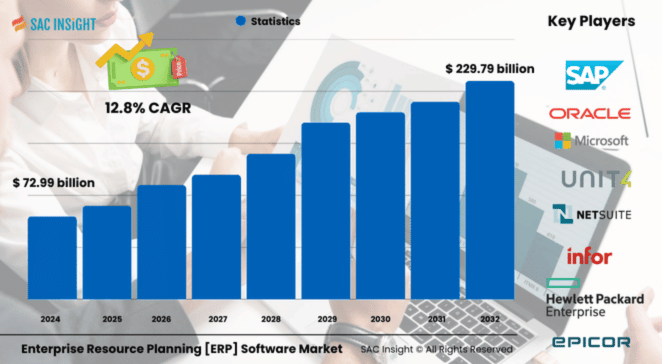
The Global enterprise resource planning (ERP) software market was valued at US$ 72.99 billion in 2024 and is projected to hit about US$ 229.79 billion by 2032, expanding at a 12.8% CAGR during the forecast period. First-hand industry insights point to three structural tailwinds: a surge in cloud and mobile accessibility, fast‑moving digital‑transformation programs, and the growing need for unified, real-time data across finance, HR, supply chain, and customer operations. SAC Insight evaluation also shows North American incumbents widening their lead in AI-driven analytics, while Asia‑Pacific outpaces on overall market growth. The U.S. ERP software industry is expected to top nearly US$ 78.62 billion by 2032, reflecting steady enterprise refresh cycles and sustainability-focused upgrades.
Summary of Market Trends & Drivers
• Cloud subscriptions and mobile ERP apps are redefining user expectations for anytime, anywhere workflows.
• Two‑tier and composable ERP strategies let multinationals blend a stable core with lighter‑weight tools at the subsidiary level, cutting rollout time and cost.
• Embedded AI, predictive analytics, and ESG dashboards are becoming standard modules, raising the bar for vendor differentiation and accelerating market growth.
Key Market Players
The competitive landscape features a mix of long‑standing Enterprise resource planning (ERP) software platform leaders and nimble cloud specialists. Major names include SAP, Oracle, Microsoft, Infor, Epicor, Sage, IBM, Unit4, Acumatica, and Workday. These vendors set the tempo through rapid cloud migration programs, low‑code extensibility, and vertical‑specific accelerators. Emerging challengers focus on AI‑assisted configuration, industry cloud templates, and usage‑based pricing to capture mid‑market share.
Key Takeaways
• Market size (2024): ≈ USD$ 72.99 billion
• Projected value (2032): ≈ USD$ 229.79 billion at a 12.8% CAGR
• North America leads with ~37% market share, but Asia-Pacific records the fastest gains.
• Cloud deployment is on track to outgrow on-premise by more than 2× through 2032.
• Finance modules remain the largest function, while HR and supply‑chain suites show double‑digit momentum.
• AI-powered forecasting, sustainability reporting, and low-code customization headline the latest market trends.
Market Dynamics
Drivers
• Urgent need to unify siloed data for faster decision-making and regulatory compliance.
• Affordable, subscription-based cloud ERP lowering entry barriers for mid-sized enterprises.
• Accelerating Industry 4.0 initiatives pushing manufacturers toward smart, integrated platforms.
Restraints
• Integration complexity with entrenched legacy systems, especially in heavily customized on-premise environments.
• Talent gaps in advanced ERP configuration and change management, slowing large-scale rollouts.
Opportunities
• ESG-ready analytics and carbon-tracking modules open new revenue streams for vendors.
• Verticalized micro-services (e.g., retail merchandising, healthcare revenue cycle) offer high-margin add-ons.
Challenges
• Heightened cybersecurity expectations demand continuous investment in zero-trust architectures.
• Evolving data-privacy laws (GDPR, CPRA, cross-border rules) raise compliance costs and deployment complexity.
Regional Analysis
North America retains leadership thanks to early cloud adoption, aggressive AI integration, and a deep pool of ERP implementation partners. Europe follows, buoyed by stringent data-privacy mandates that favor robust, compliant platforms. Asia‑Pacific, however, delivers the fastest market growth on the back of government‑backed digital-factory programs and a rising cohort of cloud-native SMEs.
• North America: AI‑embedded forecasting and sustainability add-ons drive upsell.
• Europe: Data-sovereignty and GDPR compliance shape vendor selection.
• Asia-Pacific: Double-digit CAGR powered by smart-manufacturing policies and cloud-first SMEs.
• Latin America: Gradual shift from legacy to SaaS as connectivity improves.
• Middle East & Africa: Public-sector modernization and greenfield infrastructure projects underpin steady uptake.
Segmentation Analysis
By Deployment:
• Cloud – Scalable, low-capex, fastest-growing.
Cloud ERP frees businesses from hardware upkeep and supports real-time collaboration across distributed teams, making it the default choice for new implementations.
• On-premise – Control-focused, largest installed base.
Highly regulated sectors keep on-premise systems for granular data governance, but many add cloud extensions for analytics and mobile access.
By Function (Business Function):
• Finance – Core compliance engine, ~30% revenue share.
Robust audit trails, multi-currency consolidation, and AI-driven risk scoring keep finance suites indispensable.
• Human Capital Management – Remote-work enabler, fastest function CAGR.
Self-service portals and AI chatbots streamline onboarding and performance reviews for hybrid teams.
• Supply Chain – Visibility booster, rising priority amid global disruptions.
Real-time inventory, IoT integration, and predictive ETAs mitigate bottlenecks.
• Customer Management & Others – Experience-centric, cross-sell catalyst.
Unified customer records and omnichannel support improve retention and upsell potential.
By Enterprise Size:
• Large Enterprises – Complex, multi-site, highest spend.
Global rollouts focus on standardizing processes while allowing local compliance tweaks.
• Medium Enterprises – Value-seeking, high cloud affinity.
Subscription pricing and rapid implementation templates fit lean IT budgets.
• Small Enterprises – Emerging cloud adopters.
Light‑weight, modular suites lower entry barriers for first‑time ERP users.
By Vertical / End-user:
• Manufacturing – Smart-factory backbone, largest vertical share.
Machine-to-ERP connectivity and predictive maintenance raise output quality and uptime.
• BFSI – Stringent security, real-time reporting.
Advanced encryption and regulatory dashboards meet evolving compliance rules.
• IT & Telecom – Project-centric, rapid product cycles.
Agile ERP modules align financial, resource, and subscription-billing data.
• Retail & Consumer Goods – Omnichannel agility.
Unified inventory and POS integration enable seamless online-to-store experiences.
• Healthcare & Life Sciences – Traceability and audit readiness.
Integrated quality management supports regulatory submissions and recalls.
• Government & Public Sector – Transparency and citizen-service focus.
Cloud-first policies and budget tracking drive adoption.
• Transportation & Logistics / Others – Route optimization, asset tracking.
Industry Developments & Instances
• June 2024: A top mid-market vendor acquired a product-information specialist to embed AI-powered catalog management into its ERP suite.
• March 2024: A global technology giant partnered with a leading GPU provider to accelerate industry-specific generative-AI workflows within ERP deployments.
• September 2023: A cloud ERP leader expanded its alliance with a hyperscaler to bundle “RISE”-style migration packages in Africa and other high-growth regions.
• May 2023: An enterprise software heavyweight integrated conversational AI assistants into core ERP modules for finance, supply chain, and HR.
• February 2023: A Southeast-Asian IT group launched a construction-focused cloud ERP, underscoring the rise of industry-tailored micro-clouds.
Facts & Figures
• Cloud ERP subscriptions are expected to account for over 65% of new deployments by 2030.
• AI-augmented forecasting can cut working-capital buffers by 10-15% for manufacturers adopting predictive demand planning.
• Two-tier ERP rollouts reduce subsidiary go-live times by 30‑40% compared with monolithic single-instance projects.
• North American enterprises allocate nearly 22% of IT budgets to ERP modernization, up from 17% three years ago.
• Sustainability modules within ERP platforms can lower annual ESG-reporting costs by up to US$ 0.5 million for large multinationals.
Analyst Review & Recommendations
The ERP software industry is transitioning from transactional record-keeping to intelligent, outcome-focused platforms. Vendors that combine secure, modular cloud cores with AI-driven insights and ESG-ready analytics will outpace peers. For new entrants, vertically pre-configured cloud suites targeting mid-market manufacturers or healthcare providers offer the quickest path to meaningful market share. Established providers should double down on low-code extensibility and partner ecosystems to keep pace with evolving customer expectations and fend off specialist disruptors.