Machinery and Equipment
  Pharmaceutical
  Automobile and Transportation
  Chemical & Materials
  Medical Devices
  Consumer Goods
  Semiconductor and Electronics
  Technology and Media
  Food and Beverages
  Energy and Mining
  Agriculture
  Biotechnology
  Construction
  Defense and Aeronautics
  Entertainment
  Retail
  Travel & Leisure
  Metals and Minerals
  Healthcare IT
  Oil & Gas
  Robotics & Automation
  Banking, Financial Services and Insurance (BFSI)
Key Market Insights
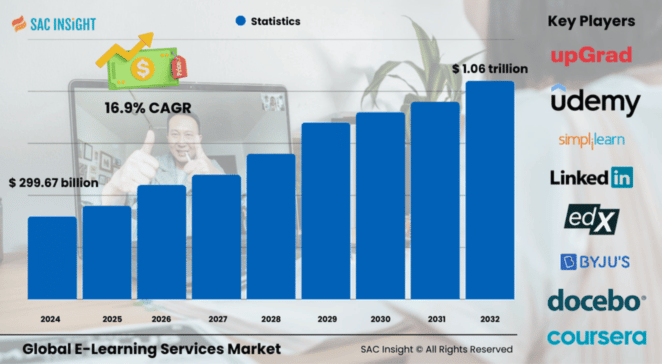
The global e-learning services market size is valued at US$ 299.67 billion in 2024 and is on track to surpass US$ 1.06 trillion by 2032, advancing at a CAGR of 16.9% from 2025-2032. First-hand industry insights show the U.S. e-learning services market alone is expected to reach US$ 220 billion by 2032, underpinned by corporate reskilling mandates and higher-ed demand for flexible degrees.
SAC Insight evaluation highlights four structural forces behind this exceptional market growth:
• A permanent shift toward remote and hybrid learning in both academia and the workplace.
• Rapid uptake of AI-driven adaptive platforms that personalise content in real-time.
• Widespread 4G/5G coverage and affordable smartphones expanding access in emerging economies.
• Government-backed digital-literacy programs that normalise online upskilling.
Summary of Market Trends & Drivers
• Subscription-based micro-learning and bite-sized credential courses are becoming the default for time-pressed professionals.
• Gamified, immersive modules using AR/VR are boosting learner engagement and completion rates, particularly in healthcare and engineering training.
• Corporations are tying learning analytics to performance reviews, turning e-learning platforms into strategic talent-management tools.
Key Market Players
The competitive landscape blends established e-learning services market enterprise software vendors with born-digital specialists. Major names profiled include Adobe, SAP, IBM, LinkedIn, Coursera, BYJU’S, Udemy, edX, Udacity, NIIT, Docebo, and upGrad. Large players are layering AI tutors and predictive analytics onto existing learning-management systems, while fast-growing challengers focus on industry-specific nano-degree programs.
Key Takeaways
• Market value (2024): USD$ 299.67 billion
• Projected value (2032): USD$ 1.06 trillion at a 16.9% CAGR
• North America commands ~35% market share, with Asia-Pacific posting the fastest gains.
• Instructor-led virtual classes remain the revenue leader, yet self-paced micro-courses are the quickest-growing format.
• Cloud-hosted learning platforms dominate deployment, but AI-enabled adaptive engines represent the hottest investment theme.
Market Dynamics
Drivers
• Always-on upskilling culture in tech-driven industries.
• Government incentives for digital education and workforce development.
• Affordable mobile data plans broadening learner pools in India, China, and Africa.
Restraints
• Limited face-to-face interaction can hinder soft-skill acquisition.
• Data-privacy regulations add compliance costs for global platform operators.
Opportunities
• White-labeled, custom e-learning solutions for regulated sectors (finance, healthcare).
• AR/VR simulations that deliver safe, hands-on practice for high-risk tasks.
• Multilingual localization to capture non-English-speaking markets.
Challenges
• Content-quality fatigue as low-barrier course creation floods the market.
• Digital-divide issues in rural regions with patchy broadband coverage.
Regional Analysis
North America leads thanks to mature digital infrastructure and a corporate culture that ties learning to career progression. Europe follows, driven by EU-level digital-education action plans, while Asia-Pacific records double-digit market trends on the back of a young, mobile-first population and aggressive government skilling initiatives.
• North America: High enterprise spending and robust ed-tech investment pipelines.
• Europe: Strong public-sector funding for digital classrooms and lifelong learning.
• Asia-Pacific: Highest CAGR; India and China dominate enrollments.
• Latin America: Rising smartphone penetration opens doors for low-cost MOOCs.
• Middle East & Africa: Government smart-city agendas fuel e-learning adoption, though bandwidth remains uneven.
Segmentation Analysis
By Type
• Custom e-learning – Tailored, brand-aligned content.
Organisations prioritize bespoke modules to meet compliance and workflow needs, keeping this segment ahead on revenue.
• Responsive e-learning – Device-agnostic delivery.
Courses that automatically adjust to screen size are now table stakes, ensuring frictionless learning on phones, tablets, and desktops.
• Micro e-learning – Five-minute nuggets, fastest CAGR.
Bite-sized lessons slot neatly into busy schedules, accelerating knowledge retention.
• Game-based learning – Engagement-first approach.
Reward systems and leaderboards drive higher completion in corporate compliance and soft-skill training.
By Course
• Instructor-led virtual courses – Real-time interaction, largest share.
Live Q&A and guided problem-solving mimic classroom dynamics, making this format popular for technical certifications.
• Self-paced courses – Flexibility fuels adoption.
Learners control timing and speed, ideal for professionals balancing work and study.
By Learning Method
• Blended learning – Hybrid gold standard.
Combines self-study modules with scheduled live sessions to maximize engagement and retention.
• Simulation – Hands-on, risk-free practice.
Healthcare, aviation, and manufacturing rely on immersive scenarios to build muscle memory.
By Technology
• Cloud computing – Scalable backbone, majority share.
Lowers upfront IT costs and enables instant global rollout of updates.
• Artificial intelligence – Personalized pathways, double-digit growth.
AI tutors, chatbots, and predictive analytics tailor content and flag knowledge gaps.
• AR/VR – Immersive training, niche but surging.
High-fidelity environments shorten learning curves for complex, manual tasks.
By End-use
• Academic – K-12 to higher-ed, dominant revenue contributor.
Institutions embed LMSs to support hybrid degrees and digital assessments.
• Corporate – Fastest-growing, fueled by reskilling mandates.
Enterprises roll out cloud platforms to standardize training across dispersed teams.
• Government – Digital-literacy and workforce programs.
Public-sector initiatives bridge skill gaps and support economic development.
Industry Developments & Instances
• July 2024: A Middle-East training provider secured private-equity funding to scale its online portfolio across the GCC.
• March 2024: A global consulting firm invested US$ 1 billion in a new learning platform and agreed to acquire a nano-degree specialist.
• August 2023: A leading textbook publisher launched a digital exam-prep suite for competitive tests in India.
• June 2023: An industry MOOC platform crossed 2.4 crore enrollments, cementing its lead in credit-bearing online courses.
• February 2022: Canada injected US$ 17.6 million into nationwide digital-literacy programs.
Facts & Figures
• Instructor-led virtual classes captured ~40% of 2024 revenue.
• Mobile learning now accounts for over 60% of total course access minutes.
• AI-powered platforms can cut content-development time by 30-40%.
• Gamified modules boost course-completion rates from 20% to nearly 50%.
• India tops global adoption with 53% of educators and learners active online.
Analyst Review & Recommendations
The e-learning services landscape is shifting from content volume to learning impact. Providers that fuse adaptive AI, immersive simulations, and outcome-based analytics into cohesive ecosystems will outpace pure-content players. We recommend doubling down on mobile-first design, localization, and industry-accredited nano-credentials to capture the next wave of demand—especially in Asia-Pacific, where demographic tailwinds and policy support point to sustained double-digit gains through 2032.