Machinery and Equipment
  Pharmaceutical
  Automobile and Transportation
  Chemical & Materials
  Medical Devices
  Consumer Goods
  Semiconductor and Electronics
  Technology and Media
  Food and Beverages
  Energy and Mining
  Agriculture
  Biotechnology
  Construction
  Defense and Aeronautics
  Entertainment
  Retail
  Travel & Leisure
  Metals and Minerals
  Healthcare IT
  Oil & Gas
  Robotics & Automation
  Banking, Financial Services and Insurance (BFSI)
Market Overview
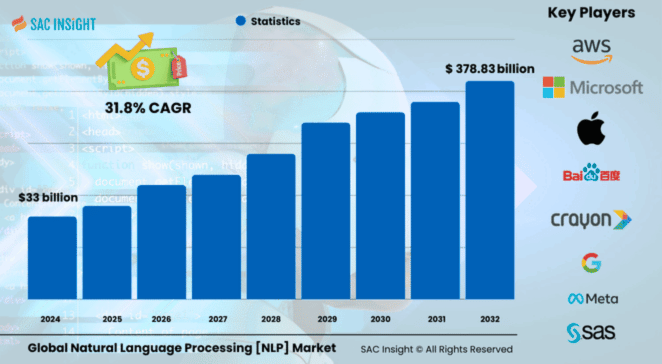
The Global natural language processing [NLP] Market size was valued at US$ ≈33 billion in 2024 and is on track to hit around US$ 378.83 billion by 2032, advancing at an average CAGR of 31.8% during 2026-2032. First-hand industry insights indicate three powerful growth engines: a surge in cloud-native AI investments, rapid consumer uptake of conversational interfaces, and deeper enterprise demand for real-time text and speech analytics. A SAC Insight evaluation also shows that post-pandemic digitization has accelerated NLP adoption across healthcare, banking, and telecom, with U.S. NLP market revenues alone expected to exceed US$ 167.32 billion by 2032. North America commands the largest market share with an average of 38.36%.
Summary of Market Trends & Drivers
• Cloud-first deployments and pay-as-you-go APIs are lowering entry barriers for start-ups and SMEs, widening the addressable customer base.
• Generative AI integration is pushing sentiment analysis and summarization tools into mainstream workflows, shortening insight-to-action cycles for marketers and product teams.
• Regulatory tailwinds—from open-banking rules to digital-health mandates—are encouraging structured data capture, which in turn fuels demand for NLP engines that can parse unstructured text and voice data.
Key Market Players
The global NLP market report profiles established leaders such as Microsoft, Google, AWS, IBM, Apple, Meta, SAP, Oracle, Baidu, 3M and, OpenAI alongside fast-growing specialists including Inbenta, Health Fidelity, and SoundHound. Collectively, these firms are shaping competitive dynamics through large-language-model (LLM) releases, vertical-specific partnerships, and a steady cadence of M&A aimed at expanding multilingual coverage and domain expertise.
Key Takeaways
• Market size (2024): US$ ≈33 billion
• Projected value (2032): ≈US$ 378.83 billion at a 31.8% CAGR
• North America commands the largest market share, but Asia-Pacific is the fastest-growing region (>40% CAGR).
• Cloud deployments already account for more than half of global revenue and continue to outpace on-premise growth.
• Statistical NLP remains dominant, yet hybrid approaches (rule-based + ML) are posting the highest incremental gains.
• Healthcare, high-tech, and BFSI collectively generate over one-third of current natural language processing market revenue.
Market Dynamics
Drivers
• Explosion of unstructured data from chat, email, and social channels requires scalable text analytics.
• Advances in transformer architectures deliver near-human accuracy in language tasks, spurring enterprise confidence.
• Edge-to-cloud AI pipelines enable real-time voice bots in retail, banking, and automotive cabins.
Restraints
• Data-security and privacy concerns (GDPR, HIPAA) raise compliance costs and slow deployments in sensitive sectors.
• Talent shortages in computational linguistics and MLOps hinder large-scale rollouts, especially among SMEs.
Opportunities
• Domain-tuned LLMs for legal, pharma, and industrial maintenance promise premium pricing and stickier contracts.
• Low-code / no-code NLP platforms open new revenue pools by empowering business analysts to build models without heavy IT support.
Challenges
• Bias mitigation and explainability remain technical hurdles that could attract regulatory scrutiny.
• Compute-cost inflation—driven by GPU shortages—pressures profitability for vendors offering inference-heavy services.
Regional Analysis
• North America: leads due to a dense ecosystem of AI vendors, strong cloud infrastructure, and early enterprise adoption.
• Asia-Pacific, however, is registering the most aggressive market growth, propelled by smartphone ubiquity, government AI initiatives, and booming e-commerce platforms.
• Europe: Focus on privacy-compliant solutions and multilingual support; steady adoption in finance and public services.
• Latin America: Emerging demand in retail and fintech; cloud migration accelerating post-pandemic.
• Middle East & Africa: Gradual expansion tied to smart-city projects and telecom modernization.
Segmentation Analysis
By Component
• Solution – Core engines, toolkits, and platforms dominate revenue.
Vendors bundle pretrained models, annotation tools, and APIs, letting developers embed NLP quickly. Solutions drive the bulk of spending because enterprises want ready-to-deploy language models that shorten time-to-value.
• Services – Fastest-growing segment as firms seek integration and customization help.
Consulting, data labeling, and model-fine-tuning services are critical for domain adaptation and ROI realization.
By Deployment
• Cloud – Majority share, high scalability, OPEX-friendly.
Pay-as-you-go clouds let companies process massive text corpora without building their own GPU clusters.
• On-Premise – Preferred for regulated workloads.
Banks and defense agencies value full control over data pipelines and latency.
• Hybrid – Bridging sensitive data on-site with elastic cloud inference.
Hybrid models balance compliance and scale, especially for global enterprises with mixed workloads.
By Enterprise Size
• Large Enterprises – Early adopters focused on predictive security and customer experience.
They integrate NLP with CRM, risk analytics, and ITSM platforms.
• SMEs – Rapid adopters via SaaS chatbots and plug-and-play voice IVR.
Affordable cloud subscriptions and prebuilt templates lower technical barriers.
By Type
• Statistical NLP – Proven accuracy, broad library support.
Still the workhorse for sentiment analysis and machine translation.
• Rule-Based NLP – Critical for compliance-driven pattern matching in healthcare and legal.
Deterministic outputs aid auditability.
• Hybrid NLP – Combines rules with ML for best-of-both performance; fastest-rising adoption.
Organizations leverage human-in-the-loop feedback to refine model outputs at scale.
By Technology
• Text Analytics – Largest share, powering voice-of-customer programs and fraud detection.
Extracts entities, topics, and sentiments from multi-language datasets.
• Interactive Voice Response (IVR) – High-growth as contact centers modernize.
AI-driven IVR slashes wait times and routes calls intelligently.
• Optical Character Recognition (OCR) & Pattern/Image Recognition.
Convert scanned docs into searchable text, streamlining KYC and claims processing.
• Speech & Emotion Analytics, Classification & Categorization
Others round out specialized use cases from in-car assistants to HR screening.
By Application
• Sentiment Analysis – Core for brand monitoring and product feedback loops.
Retailers leverage real-time mood tracking to tailor offers.
• Risk & Threat Detection – Essential for compliance and cybersecurity.
Banks flag suspicious transactions; telecoms detect network abuse.
• Others Applications and use cases.
Automatic Summarization, Content Management, Data Extraction, Language Scoring, and other niche tasks are growing as enterprises automate knowledge work.
By End-use
• Healthcare – Largest vertical share.
Clinical documentation, drug-discovery text mining, and patient-chat triage dominate spending.
• IT & Telecom – Fastest CAGR.
NLP powers network ticket classification, smart routing, and multilingual chatbots.
• BFSI, Retail & E-commerce, Education, Media & Entertainment, Automotive & Transportation, Manufacturing, Government all display rising adoption curves as digital transformation deepens.
Industry Developments & Instances
• Mar 2023: Kensho Technologies launched Kensho Classify, boosting conceptual document tagging for finance clients.
• Feb 2023: Bain & Company partnered with OpenAI to embed GPT models into enterprise transformation projects.
• Jul 2022: SAP acquired Askdata, adding AI-driven natural-language search to its analytics suite.
• Jul 2022: Reddit bought MeaningCloud to strengthen ML-based ad relevance via deeper sentiment parsing.
• May 2020: Apple’s purchase of Inductiv enhanced Siri’s data-cleaning and on-device learning capabilities.
Facts & Figures
• Cloud deployments account for ≈60% of total NLP Market revenue today.
• 81% of global enterprises now run multi-cloud NLP workloads.
• Healthcare captures ≈23% of market size, led by clinical-note automation projects.
• Text analytics cuts customer-feedback processing time by up to 70%.
• Hybrid NLP models improve precision by 15-20 percentage points over standalone rule-based systems.
Analyst Review & Recommendations
NLP has moved from experimental to mission-critical in under five years. Vendors that pair domain-specific LLMs with transparent governance tooling will set the competitive tempo. Buyers should prioritize platforms offering low-code customization, robust data-privacy controls, and GPU-efficient inference to contain costs. Over the next decade, sustained market growth will hinge on tackling bias, securing multilingual talent, and delivering explainable outputs that regulators and end-users can trust.