Machinery and Equipment
  Pharmaceutical
  Automobile and Transportation
  Chemical & Materials
  Medical Devices
  Consumer Goods
  Semiconductor and Electronics
  Technology and Media
  Food and Beverages
  Energy and Mining
  Agriculture
  Biotechnology
  Construction
  Defense and Aeronautics
  Entertainment
  Retail
  Travel & Leisure
  Metals and Minerals
  Healthcare IT
  Oil & Gas
  Robotics & Automation
  Banking & Finance
Market Overview
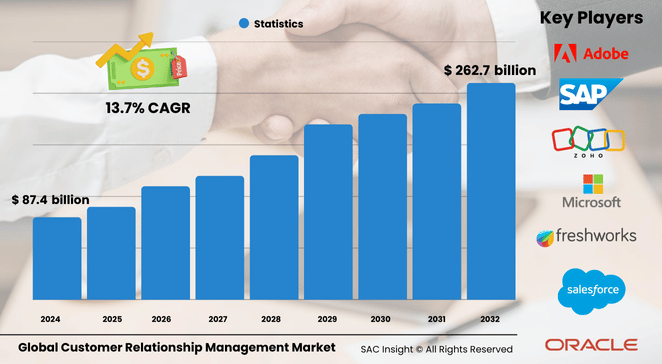
The global customer relationship management [CRM] market was valued at US$ 87.41 billion in 2024 and is projected to reach US$ 262.74 billion by 2032, registering a robust 13.7% CAGR over the 2025–2032 forecast window. First-hand industry insights reveal that hyper-personalized customer journeys, AI-driven automation, and rapid cloud adoption are moving CRM from a back-office database to the strategic center of customer engagement. SAC Insight's deep market evaluation also shows a decisive shift to mobile-first and omnichannel support, positioning CRM platforms as the backbone of digital-first business models.
North America continues to lead, and the region’s CRM market is expected to surpass US$ 320.62 billion by 2032, with the U.S. market segment capturing most of that revenue through aggressive investment in analytics-rich, cloud-native suites.
Summary of Market Trends & Drivers
AI-enabled analytics, low-code workflow builders, and generative conversational tools are transforming how organizations capture insights and act on them in real time. At the same time, a surge in social commerce and embedded mobile experiences is forcing brands to unify data silos so they can deliver consistent service across every touchpoint, sustaining market growth and elevating customer expectations.
Key Market Players
The global CRM leaders such as Salesforce, Microsoft, SAP, Oracle, Adobe, and Zendesk dominate the competitive landscape with expansive product ecosystems that weave sales, service, marketing, and analytics into a single cloud fabric. Their ongoing investments in generative AI, industry-specific modules, and marketplace integrations keep switching costs high and customer churn low. Around this core, a dynamic cohort—including HubSpot, Freshworks, Zoho, SugarCRM, Insightly, Copper, monday.com, Nimble, and Creatio—competes through no-code configuration, vertical templates, and attractive pricing aimed at small and mid-size enterprises. Strategic alliances, frequent feature drops, and targeted acquisitions remain the primary levers for differentiation and share gain.
Key Takeaways
• Market size (2024): USD$ 87.41 billion
• Projected market size (2032): USD$ 262.74 billion at a 13.7% CAGR
• North America holds roughly 42.8% market share in 2024
• Customer service solutions command the largest revenue share (22% in 2024)
• BFSI is the leading end-use vertical, closely followed by retail and healthcare
• Cloud deployment represents over 58% of 2024 revenue and continues to outpace on-premise installations
Market Dynamics
Drivers
• Accelerating digital transformation mandates unified, real-time customer data for personalized engagement
• AI and machine learning enhance lead scoring, churn prediction, and next-best-action recommendations
• Rising mobile and social commerce volumes pressure brands to deliver instant, contextual support
Restraints
• Integration complexity with legacy systems can slow time-to-value and inflate project costs
• Data-privacy regulations increase compliance burdens, especially for cross-border data flows
• A shortage of skilled CRM administrators and developers limits customization in some regions
Opportunities
• Verticalized CRM suites for industries such as healthcare, manufacturing, and public sector open high-margin niches
• Embedded generative AI assistants promise step-change productivity gains for front-line teams
• Growing SME appetite for subscription-based, no-code platforms widens the addressable base
Challenges
• Vendor lock-in concerns drive demand for open APIs and flexible data portability
• Cybersecurity threats elevate risk for cloud-hosted customer data
• Economic uncertainty pressures IT budgets, demanding faster ROI from CRM investments
Regional Analysis
North America retains the largest CRM Market share thanks to early cloud adoption, strong SaaS spending, and an innovation-centric customer base. Asia Pacific, fueled by vast e-commerce ecosystems and government-led digital initiatives, is the fastest-growing region, while Europe advances through stringent data-governance standards that favor trusted, compliant vendors.
• North America – Early AI uptake, high cloud penetration, and strong demand for mobile CRM keep growth steady. Expected to reach USD$ 320.62 billion by 2032.
• Europe – Data-privacy rigor and rising need for omnichannel engagement boost enterprise upgrades
• Asia Pacific – Double-digit expansion driven by India’s SME cloud adoption and China’s e-commerce scale
• Latin America – Rapid smartphone adoption and competitive retail sectors accelerate cloud CRM rollouts
• Middle East & Africa – Investments in digital infrastructure and retail modernization create emerging opportunities
Segmentation Analysis
By Solution
• Customer Service – Largest share, center of loyalty efforts. Customer service tools anchor many deployments, linking case management, knowledge bases, and chatbots to drive faster resolutions and richer self-service options. Quality of service remains the prime differentiator in crowded consumer markets.
• Customer Experience Management – High-growth segment. Beyond ticketing, platforms now map customer sentiment and journey milestones, helping brands deliver friction-free, personalized experiences that translate into higher lifetime value.
• Analytics – Unlocks predictive insights. Embedded dashboards and AI models transform raw data into actionable intelligence, guiding sales forecasts, marketing spend, and service staffing.
• Marketing Automation – Expands multichannel reach. Automated email, SMS, and social campaigns help companies nurture leads and upsell existing customers with minimal manual effort.
• Salesforce Automation – Streamlines revenue operations. Deal tracking, pipeline visibility, and automated quoting reduce administrative drag and free reps to focus on relationship-building.
• Social Media Monitoring – Fastest CAGR at 17.2%. Real-time brand sentiment analysis and engagement tools meet consumers where they spend much of their time, shaping proactive service strategies.
• Others – Includes CPQ, partner management, and IoT connectors. Specialized modules extend CRM footprints into pricing workflows, reseller ecosystems, and connected-device support.
By Deployment
• Cloud – Dominant and accelerating. Subscription pricing, rapid updates, and remote-work enablement make cloud the default choice, especially for new implementations. Scalability and lower upfront cost appeal to both enterprises and SMEs. Cloud platforms let teams collaborate from anywhere, integrate with modern stacks, and scale resources on demand—critical advantages in volatile markets.
• On-Premise – Niche yet resilient. Large enterprises with strict data-sovereignty or latency requirements continue to favor on-premise setups, valuing direct control over infrastructure and security posture. Although growth is slower, on-premise deployments remain essential for regulated industries needing full custody of sensitive information.
By Enterprise Size
• Large Enterprises – 59.9% share in 2024. Complex, multi-departmental organizations leverage AI-enriched CRM to harmonize global sales and service processes and drive ROI from vast customer datasets. With deep pockets and sizable user bases, large enterprises prioritize analytics, security, and integrations, keeping high-end vendors in demand.
• Small & Medium Enterprises – Fastest CAGR at 16.2%. SaaS affordability and no-code customization let SMEs adopt enterprise-grade capabilities without heavy IT lift, leveling the competitive playing field. Pay-as-you-grow subscription models help smaller firms deploy modern CRM quickly, enhancing professionalism and customer perception.
By End Use
• BFSI – Market leader. Banks and insurers rely on unified customer views to tailor financial products, comply with KYC, and elevate service standards, driving sustained adoption.
• Retail & Consumer Goods – Data-rich, experience-driven. Omnichannel shopping behaviors push retailers to track inventory, promotions, and customer preferences in one place, enabling agile, personalized campaigns.
• Healthcare – Growing focus on patient engagement. Providers employ CRM to coordinate care, improve follow-ups, and manage population health initiatives, boosting operational efficiency and outcomes.
• IT & Telecom, Manufacturing, Government, Transportation & Logistics, and Others – All see rising value in predictive insights, service consistency, and data governance as digital transformation gains momentum.
Industry Developments & Instances
• November 2023 – Creatio partnered with a Singapore consultancy to deploy its no-code platform across Southeast Asia, accelerating regional expansion
• September 2023 – A leading CX vendor and a prominent CRM provider launched a joint AI-powered solution linking contact-center data with CRM workflows
• July 2023 – Salesforce released Sales Planning, an end-to-end territory, quota, and capacity tool embedded in core CRM data
• June 2023 – SugarCRM linked with a sales-analytics firm to deliver vertical AI insights for manufacturing and distribution clients
• January 2023 – A major cloud vendor enhanced its SMB-focused CRM with multi-pipeline team functionality and marketplace “toppings” for easy extensibility
Facts & Figures
• Roughly 80% of organizations use CRM for sales reporting and process automation
• Customer service holds a 22% solution revenue share, reflecting its role as the frontline value driver
• Cloud deployment accounts for over 58% of global CRM spend, and 87% of CRM users rely primarily on cloud platforms
• North America commanded 42.8% of global revenue in 2024, while Asia Pacific posts the highest regional CAGR at 16.3%
• The BFSI vertical led 2024 adoption, followed by retail; together they contributed more than one-third of total CRM revenue
Analyst Review & Recommendations
The CRM market’s trajectory underscores a decisive pivot from record-keeping to intelligence-oriented engagement. Vendors that marry secure, open architectures with embedded AI and industry-specific depth will dictate the next growth phase. Buyers should prioritize platforms offering flexible APIs, low-code customization, and robust privacy safeguards to future-proof investments. Over the next decade, CRM systems that seamlessly blend predictive insights with human empathy will set the benchmark for sustained customer loyalty and profitability.