Machinery and Equipment
  Pharmaceutical
  Automobile and Transportation
  Chemical & Materials
  Medical Devices
  Consumer Goods
  Semiconductor and Electronics
  Technology and Media
  Food and Beverages
  Energy and Mining
  Agriculture
  Biotechnology
  Construction
  Defense and Aeronautics
  Entertainment
  Retail
  Travel & Leisure
  Metals and Minerals
  Healthcare IT
  Oil & Gas
  Robotics & Automation
  Banking & Finance
Market Overview
The global speech and voice recognition market size was valued at US$ 15.46 billion in 2024 and is estimated at US$ 21.70 billion for 2025. SAC Insight's deep market analysis indicates the sector is set to reach roughly US$ 132.74 billion by 2032, expanding at a 25.35% CAGR over the 2025-2032 forecast period. First-hand industry insights reveal four structural growth engines: the surge in AI-enabled consumer devices, rising enterprise demand for contact-free interfaces, accelerating cloud adoption among small and mid-sized businesses, and expanding voice biometrics for secure authentication. In the U.S. speech and voice recognition market alone, more than 45 million adults already use voice search for shopping, underscoring mainstream acceptance.
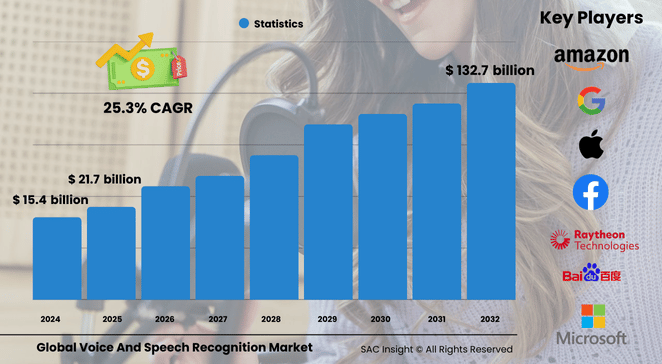
Summary of Market Trends & Drivers
• Machine learning and large-language-model breakthroughs are driving rapid accuracy gains, enabling real-time multilingual transcription and richer voice user interfaces.
• Hybrid cloud and on-device processing architectures are widening access for smaller firms, cutting upfront costs, and fueling market growth across emerging economies.
• Privacy-aware voice biometrics are moving beyond banking into healthcare and government services, where secure, hands-free authentication is critical.
Key Market Players
The competitive landscape features established technology giants alongside specialized voice innovators. Leading platforms from Alphabet, Amazon, Microsoft, IBM, and Apple dominate large-scale deployments, while Baidu and iFLYTEK spearhead regional language innovation in Asia. Niche specialists such as SESTEK, LumenVox, and Sensory focus on domain-specific speech engines, edge inference, and embedded voice control, keeping competitive pressure high and product refresh cycles short.
Key Takeaways
• The global speech and voice recognition market share leadership currently rests with North America, yet Asia-Pacific is the fastest-growing region through 2032.
• Web-conference transcription accounts for roughly 44 percent of application revenue, highlighting enterprise collaboration as a core demand engine.
• The consumer vertical contributes the largest revenue slice, thanks to smart speakers, voice assistants, and connected wearables.
• Cloud deployments are scaling faster than on-premise solutions as SMEs prioritize flexible, pay-as-you-go models.
• Automatic speech recognition (ASR) remains the dominant technology, but voice recognition for biometric security is accelerating.
• AI-driven accuracy improvements and customizable language models are lowering entry barriers for new use cases.
Market Dynamics
Drivers
• Proliferation of AI-enabled devices and IoT endpoints demanding natural voice interfaces.
• Rising enterprise focus on contactless customer experiences and productivity automation.
• Growing regulatory acceptance of voice biometrics for secure, compliant authentication.
Restraints
• Persistent concerns over data privacy, storage practices, and potential voice data breaches.
• Accuracy challenges with diverse accents, jargon, and noisy environments in real-world deployments.
Opportunities
• Cloud-based speech-to-text services offering scalable, low-cost entry for start-ups and SMEs.
• Industry-specific language packs (medical, legal, automotive) that improve transcription precision and unlock premium pricing.
Challenges
• Lack of global standardization for voice data formats and performance benchmarks.
• Continuous need to update models with evolving vocabularies, which demands significant annotated data and expert oversight.
Regional Analysis
North America holds the largest market share, supported by a mature technology ecosystem, high smart-device penetration, and early enterprise adoption. Asia-Pacific is posting the fastest market growth, propelled by mobile-first consumers, massive multilingual populations, and government-backed digitalization drives. Europe follows with strong uptake in automotive voice control and compliance-driven biometric applications, while Latin America and the Middle East & Africa show steady gains as cloud connectivity improves.
• North America – Largest revenue base; strong consumer uptake and enterprise investment.
• Europe – Robust adoption in automotive, healthcare, and multilingual virtual assistants.
• Asia-Pacific – Highest CAGR, fueled by smartphone ubiquity and regional language innovation.
• Latin America – Growing demand for voice biometrics in banking and call-center automation.
• Middle East & Africa – Emerging opportunities in smart city and public-sector deployments.
Segmentation Analysis
By Technology
• Speech Recognition – Core engine for transcription and command execution. Continuous accuracy gains and integration with virtual reality tools keep this segment in the lead for enterprise documentation and consumer voice search.
• Voice Recognition – Biometric identification and verification. As fraud prevention tightens, voice recognition is expanding rapidly in finance, healthcare, and government services.
• Automatic Speech Recognition (ASR) – High-accuracy, real-time text output. ASR dominates due to its versatility across chatbots, call-center analytics, and hands-free consumer devices.
• Speech-to-Text – Cloud and edge conversion of spoken language. The segment benefits from scalable APIs that shorten deployment times for app developers.
By Deployment
• Cloud – Fastest-growing mode. Organizations favor cloud for elastic compute, reduced capital outlay, and seamless model updates.
• On-Premises / Embedded – Security-driven choice. Selected where strict data residency or ultra-low latency is required, such as defense or industrial automation.
By End-user / Vertical
• Healthcare – Dictation, telehealth, and electronic health record integration. Clinicians rely on speech interfaces to cut documentation time and enhance patient interaction.
• IT & Telecommunications – Core infrastructure for virtual assistant ecosystems. Network operators bundle voice services into broadband and 5G offerings.
• BFSI – Voice biometrics for frictionless, two-factor authentication. Banks deploy conversational interfaces for account servicing while curbing identity fraud.
• Automotive – In-car voice control for navigation, infotainment, and safety. Drivers increasingly expect voice-first interactions to minimize distraction.
• Government & Legal – Secure, closed-loop transcription and case management. Agencies adopt on-premise voice solutions to meet confidentiality mandates.
• Education – Real-time captioning and language learning tools. Hybrid classrooms leverage speech recognition for accessibility and engagement.
• Retail & Ecommerce – Voice-enabled shopping and customer service. Brands integrate conversational commerce to shorten purchase journeys.
• Media & Entertainment – Subtitle generation and content searchability. Studios use automated captions to boost accessibility and global reach.
Industry Developments & Instances
• January 2024 – A memory-assist mobile device integrated adaptive speech recognition to aid users with non-standard speech patterns.
• November 2023 – A legal software platform embedded cloud-based dictation, streamlining case notes for attorneys.
• May 2023 – A leading video-conferencing suite partnered with a voice-tech start-up to add real-time captioning for users with speech impairments.
• September 2023 – A major virtual assistant announced a large-language-model upgrade that delivers more conversational responses and better personalization.
• June 2022 – A microcontroller supplier teamed with an embedded-speech pioneer to simplify voice UI development for smart-home devices.
Facts & Figures
• Average global CAGR 2025-2032: 25.35 percent.
• Projected global market value 2032: USD$ 132.74 billion.
• Web-conference transcription share: approximately 44 percent of total revenue.
• Consumer vertical contribution: largest segment, ahead of enterprise and automotive.
• Multilingual accent and dialect concerns: reported by roughly 30 percent of industry participants.
• Voice commerce usage: 45 million U.S. adults made at least one purchase via voice search.
Analyst Review & Recommendations
SAC Insight's deep market evaluation suggests the speech and voice recognition market is entering an accelerated deployment phase where accuracy improvements, cloud scalability, and secure biometrics converge. Vendors that pair domain-specific language models with privacy-centric architectures will outpace competitors. For new entrants, lightweight, API-first solutions targeting emerging-market developers present the quickest path to scale. Established providers should double down on on-device inference and hybrid architectures to balance latency, cost, and data sovereignty concerns and sustain long-term market growth.