Machinery and Equipment
  Pharmaceutical
  Automobile and Transportation
  Chemical & Materials
  Medical Devices
  Consumer Goods
  Semiconductor and Electronics
  Technology and Media
  Food and Beverages
  Energy and Mining
  Agriculture
  Biotechnology
  Construction
  Defense and Aeronautics
  Entertainment
  Retail
  Travel & Leisure
  Metals and Minerals
  Healthcare IT
  Oil & Gas
  Robotics & Automation
  Banking, Financial Services and Insurance (BFSI)
Market Overview
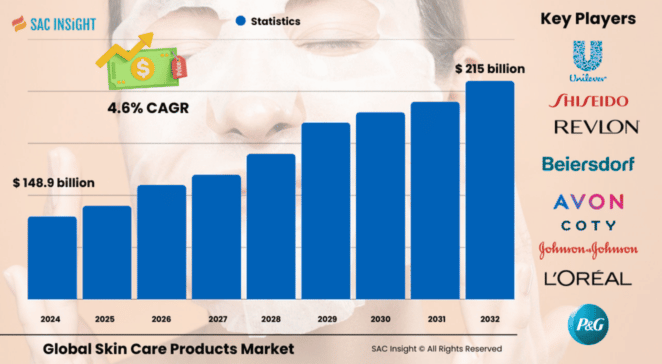
The global skin care products market size was estimated at around US$ 148.9 billion by 2024. It is set to reach roughly US$ 215.0 billion by 2032, registering a steady 4.695% CAGR over the 2025-2032 forecast window. SAC Insight industry insights highlight three structural forces behind this market growth: rising demand for naturally derived formulations, surging online sales that shorten the path to purchase, and new celebrity or influencer-led labels that broaden consumer reach.
SAC Insight's deep market evaluation shows a full rebound from pandemic-era store closures, with spending now well above 2019 levels. The U.S. skin care products market alone is expected to top US$ 60 billion by 2032 as shoppers pay premium prices for science-backed, dermatologist-tested lines.
Summary of Market Trends & Drivers
Consumer migration toward vegan, cruelty-free, and “clean beauty” portfolios is reshaping product pipelines and marketing messages. Skinimalism—fewer steps, multifunctional products—is pushing brands to develop high-performance hybrids combining sun protection, hydration, and active botanicals in a single SKU. Precision skin care powered by AI-based diagnostics and DNA or microbiome testing is opening the door for personalized regimens delivered direct-to-consumer.
Key Takeaways
- Asia Pacific commands the largest regional market share at 39.65% and remains the hub for K-beauty and ingredient innovation.
- Face creams & moisturizers contribute the biggest product slice, accounting for 42.11% of global revenue.
- Female consumers still account for 61.66% of spending, yet the men’s segment is the fastest-growing at about 5% CAGR.
- Supermarkets & hypermarkets dominate physical retail, but pure-play online platforms are capturing incremental gains through subscription models and influencer storefronts.
Key Market Players
Global leadership rests with diversified giants that blend mass-market reach and research muscle. Companies such as L’Oréal, Unilever, Procter & Gamble, and Johnson & Johnson continue to invest heavily in R&D and digital shelf visibility. Around them, challenger brands like Shiseido’s Humanrace, Beiersdorf’s NIVEA Accelerator alumni, and fast-growing disruptors acquired by strategic buyers (e.g., SkinBetter Science, Youth to the People, Tula) inject fresh concepts and ingredient stories that keep the competitive tempo high. Strategic partnerships with e-commerce platforms and dermatologist networks underpin their expanding skin care products market share.
Market Dynamics
Drivers
Expanding middle-class income in emerging markets supports premiumisation and routine-based purchases. Growing awareness of photo-aging and pollution-induced damage drives uptake of SPF-infused and anti-pollution lines.
Restraints
Ingredient transparency demands and evolving clean-label regulations raise formulation costs and time-to-market. Counterfeit products on informal online channels erode brand trust and compress margins.
Opportunities
Bio-fermented actives and upcycled botanical extracts offer new functional claims and circular-economy narratives. AI-powered skin analysis apps paired with refillable packaging present a path to recurring revenue and lower environmental impact.
Challenges
Intense competition leads to shorter product life cycles and higher marketing spend to retain consumer mindshare. Supply-chain disruptions for specialty ingredients (e.g., niacinamide, hyaluronic acid) can stall new launches and limit scale-up.
Regional Analysis
Asia Pacific continues to set the pace, propelled by K-beauty influence, a vibrant chemical industry for raw materials, and increasing male grooming adoption. North America posts solid single-digit growth on the back of science-driven brand storytelling, while Europe benefits from strict regulatory standards that reassure ingredient-conscious consumers.
Asia Pacific – Largest market; strong domestic manufacturing in China and South Korea supports export-ready innovation.
North America – Fastest revenue expansion; high consumer willingness to pay for dermatologist-endorsed formulations.
Europe – Mature but resilient; sustainability and packaging regulations shape product design.
Latin America – Rising urbanization and social-media penetration fuel demand for affordable premium lines.
Middle East & Africa – Gradual uptake aided by expanding modern retail and rising tourism-driven luxury spending.
Segmentation Analysis
By Product
Face Creams & Moisturizers – High stickiness, dominant share
These everyday staples offer hydration plus active benefits, making them the cornerstone of most routines. Continued innovation in lightweight textures and plant-based emulsifiers keeps this segment in the lead.
Cleansers & Face Wash – Essential gateway category
With consumers washing more frequently to remove pollution and SPF, gentle surfactant systems and microbiome-friendly formulas are in demand.
Sunscreen – Preventive focus, double-digit momentum
Broad-spectrum and blue-light-shielding variants gain traction as skin-cancer awareness rises and hybrid products merge SPF with makeup or serum benefits.
Body Creams & Moisturizers – Daily use, rising naturals mix
Shea-butter and ceramide-rich lotions find favor among consumers tackling dryness from climate extremes and indoor heating.
Shaving Lotions & Creams – Corporate grooming driver
More professionals aim for irritation-free shaving; botanically enriched and alcohol-free options are expanding shelf space.
Others – Niche boosters and masks
Fast-acting ampoules, sleep masks, and spot-correcting patches satisfy targeted concerns and social-media-driven experimentation.
By Gender
Female – Core revenue engine
Women maintain skincare as self-care, embracing active-rich serums and multi-step rituals that drive basket size.
Male – Quickest growth path
Men shift beyond basic cleansers toward anti-aging, oil-control, and sun-protection solutions, supported by gender-neutral branding and influencer advocacy.
By Distribution Channel
Supermarkets & Hypermarkets – High visibility, value appeal
One-stop convenience and promotional pricing secure broad penetration for mass and masstige labels alike.
Convenience Stores – On-the-go replenishment
Small-format shops benefit from travel-size SKUs that cater to impulse purchases and commuter traffic.
Pharmacy & Drugstore – Trust-based positioning
Dermocosmetic lines leverage pharmacist endorsement and in-store skin diagnostics to win loyalty.
Online – Double-digit surge
Live-stream shopping, subscription kits, and AI-driven quizzes personalize the journey and boost conversion.
Others – Salons, department stores, specialty boutiques
Experiential merchandising and professional recommendations reinforce premium and spa-grade offerings.
Industry Developments & Instances
July 2021 – Launch of a next-generation power-infusing serum by a leading Japanese brand, available in 380 domestic stores and online.
June 2021 – Expansion of a German-based accelerator into China, partnering with a major e-commerce platform to incubate indie beauty tech startups.
June 2021 – Introduction of a six-SKU dermatologist-designed range in U.S. pharmacy chains, bringing mid-priced clinical care to mass retail.
September 2022 – Acquisition of a physician-dispensed anti-aging specialist by a global beauty conglomerate, strengthening its premium professional portfolio.
January 2022 – A multinational consumer goods group purchased a probiotic-powered clean skincare label to enhance its science-backed natural offerings.
December 2021 – Agreement to acquire a California-based vegan superfood brand, broadening access to Gen-Z consumers seeking nutrient-dense formulas.
Facts & Figures
- Current market size (2024): US$ 148.9 billion
- Projected 2032 value: US$ 215.0 billion at a 4.695% CAGR
- Asia Pacific holds 39.65% market share, led by China, South Korea, and India
- Face creams & moisturizers account for 42.11% of global revenue
- Female consumers generate 61.66% of sales, while men’s products lead in market growth at 5% CAGR
- Supermarkets & hypermarkets capture 43.72% of distribution share, yet online sales are growing twice as fast
Analyst Review & Recommendations
Robust consumer appetite for transparent labels, science-validated actives, and tailored regimens continues to power the skin care products market. Brands that marry clean-ingredient narratives with measurable efficacy—and deliver them through frictionless e-commerce experiences—stand to capture outsized market share. Investment in AI-driven diagnostics, refillable packaging, and regional micro-influencer partnerships will be key levers for sustained market analysis-driven expansion.