Machinery and Equipment
  Pharmaceutical
  Automobile and Transportation
  Chemical & Materials
  Medical Devices
  Consumer Goods
  Semiconductor and Electronics
  Technology and Media
  Food and Beverages
  Energy and Mining
  Agriculture
  Biotechnology
  Construction
  Defense and Aeronautics
  Entertainment
  Retail
  Travel & Leisure
  Metals and Minerals
  Healthcare IT
  Oil & Gas
  Robotics & Automation
  Banking & Finance
Market Overview
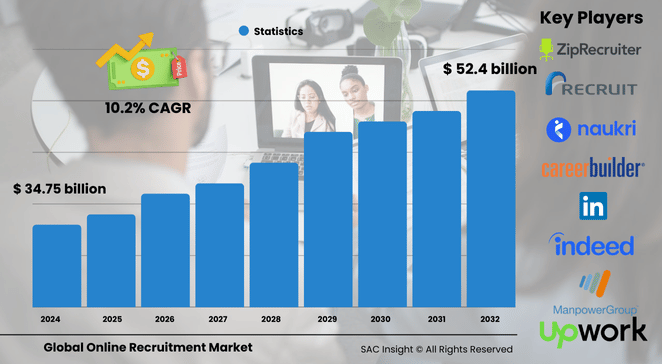
The global online recruitment market size was valued at about US$ 34.75 billion in 2024 and is on track to reach roughly US$ 52.4 billion by 2032, expanding at a 10.2% CAGR throughout 2025-2032. First-hand industry insights show three structural tailwinds: employers want faster hiring cycles, jobseekers expect mobile-first experiences, and artificial-intelligence tools now match candidates to roles with unprecedented accuracy.
SAC Insight's deep market evaluation also confirms that permanent placements still dominate revenue, while chatbots and video interviewing continue to streamline candidate engagement. The U.S. online recruitment market is forecast to approach US$ 28.8 billion by 2032 as domestic employers widen their talent search and rely on data-driven screening.
Market Trends & Drivers
• Mainstream use of social media for talent sourcing, with recruiters blending job boards, LinkedIn, and Instagram to widen reach and boost employer branding.
• Rapid adoption of AI-powered screening, automated interview scheduling, and mobile application flows, cutting average time-to-hire to just over five weeks.
• Shift toward remote and hybrid work, prompting companies to advertise roles globally and candidates to demand flexible employment options.
Key Market Players
LinkedIn, Indeed, Monster Worldwide, Zoho, and iCIMS anchor the competitive landscape with extensive user bases and integrated applicant-tracking capabilities. Emerging specialists such as TalentLyft, BambooHR, and HackerRank differentiate through AI-driven sourcing, niche assessment libraries, and lightweight collaboration tools that appeal to high-growth startups. Together, these firms set the tone for product innovation—from conversational chatbots that answer applicant queries in real time to candidate-relationship platforms that nurture passive talent pools.
Key Takeaways
• Market value (2024): USD$ 34.75 billion
• Projected value (2032): USD$ 52.4 billion at a 10.2% CAGR
• North America retains the largest market share at just over 35%, led by robust tech hiring and widespread internet penetration.
• Permanent online recruitment commands more than 80% of revenue, while part-time and gig placements are the fastest-growing slice.
• IT roles account for roughly one-quarter of all online hiring, reflecting ongoing digital transformation across industries.
• Chatbots and AI-based video interviewing represent the highest-growth technology layers, improving candidate engagement and cutting screening costs.
Market Dynamics
Drivers
• Proliferation of AI, machine learning, and predictive analytics that automate resume parsing, improve candidate matching, and lower cost-per-hire.
• Rising demand for remote talent pools, allowing employers to source skills independently of location and time zone.
• High smartphone penetration and faster mobile networks, enabling jobseekers to search and apply on the go.
Restraints
• Persistent data-privacy and cybersecurity concerns that push platforms to invest heavily in compliance and breach prevention.
• Risk of fraudulent applications and identity spoofing, which forces recruiters to layer additional verification steps and may slow the funnel.
Opportunities
• Expansion into high-growth emerging markets in Asia-Pacific, Latin America, and Africa as internet access and startup ecosystems accelerate.
• Development of bias-mitigation features—such as blind screening and inclusive language checks—to help employers meet diversity goals.
Challenges
• Navigating diverse labor regulations and data-protection laws across multiple jurisdictions, increasing operational complexity and cost.
• Keeping pace with rapid technology cycles while integrating new tools into legacy HR systems without disrupting daily recruiting workflows.
Regional Analysis
The North America online recruitment market leads global revenue thanks to a large technology sector, advanced digital infrastructure, and early adoption of AI-driven recruitment tools. Europe follows, bolstered by strong enterprise uptake and regulatory pushes for transparent hiring. Asia-Pacific is the fastest-growing region as mobile usage surges and multinational firms expand local footprints.
• North America – High market penetration, strong preference for data-rich applicant-tracking systems, and aggressive investment in recruiter tech stacks.
• Europe – Emphasis on GDPR-compliant platforms and multilingual candidate experiences.
• Asia-Pacific – Double-digit market growth powered by smartphone ubiquity, rising startup activity, and government digital-skilling programs.
• Latin America – Expanding adoption among midsize enterprises seeking cost-effective hiring across diverse geographies.
• Middle East & Africa – Gradual shift from traditional recruitment agencies to online portals as internet access widens.
Segmentation Analysis
By Type
• Permanent Online Recruitment – Dominant revenue stream
Permanent placements capture over four-fifths of market share because employers still view full-time hires as the cornerstone of long-term strategy.
• Part-Time Online Recruitment – Flexibility-driven growth
Part-time and project-based roles appeal to gig workers, students, and retirees.
By Application
• IT – Largest slice at roughly 25%
Continuous cloud, cybersecurity, and software initiatives keep IT hiring robust. Platforms use skills-based filters and coding challenges to separate top engineers from a crowded applicant pool.
• Finance – Strong demand for compliance and analytics talent
Banks and fintech firms leverage AI-screening tools to vet credentials quickly while adhering to stringent regulatory standards.
• Marketing & Sales – Rising emphasis on digital skillsets
The pivot toward e-commerce and data-driven campaigns pushes employers to secure social-media specialists, growth hackers, and account executives through targeted job ads.
• Engineering – Complex, high-value placements
Advanced matching algorithms help manufacturers, energy firms, and construction companies find niche engineering talent faster, cutting vacancy downtime.
• Hotel & Catering – High-turnover segment
Automated scheduling and video interviews speed up front-line hiring, critical for peak tourist seasons.
• Others – Healthcare, customer service, and administrative roles continue to migrate online as demand for remote staffing grows.
By Technology
• Chatbots – Fastest CAGR within the stack
Conversational AI handles FAQs, schedules interviews, and nudges candidates, improving response rates and reducing recruiter workload.
• Candidate Relationship Management Platforms – Talent-nurture engines
These systems maintain warm pools of passive candidates, track engagement scores, and trigger timely outreach campaigns.
• Applicant Tracking Systems – Core workflow backbone
ATS solutions centralize postings, resumes, and interview feedback while supporting compliance reporting and collaboration.
• Video Interviewing (AI-Based) – Remote evaluation booster
AI analyzes verbal and non-verbal cues to shortlist applicants, enabling recruiters to screen high volumes efficiently and cut travel costs.
Industry Developments & Instances
• April 2023 – A new Recruiter Marketplace went live, automating connections between employers and freelance recruiters for flexible, pay-as-you-go sourcing.
• 2023 – LinkedIn rolled out Talent Hub, delivering real-time labor-market insights inside its recruiting suite.
• 2023 – Zoho expanded its Recruit platform to fold onboarding and payroll into one workflow.
• 2023 – SmartRecruiters enhanced its interview scheduler with multi-day booking and remote-work tags.
• 2022 – TestGorilla raised USD$ 70 million to scale its assessment library and cut bias in hiring.
• 2021 – A leading CRM-for-recruitment provider launched a WeChat integration, allowing Chinese users to apply in-app and receive real-time updates.
Facts & Figures
• Roughly 79% of jobseekers rely on online resources during their search.
• An average job listing attracts about 250 applications.
• 92% of employers use social media for recruiting, and 72% screen candidates’ profiles before outreach.
• Average cost per hire sits near USD$ 4,000 while AI adoption lowers that figure by around 20%.
• Typical click-through rate on digital job ads is 11%, and average time-to-fill via online methods is 36 days.
• Mobile devices generate 16% of total applications, with 45% of seekers checking listings from their phones daily.
Analyst Review & Recommendations
Online recruitment is moving from simple job postings to end-to-end, data-powered talent ecosystems. Vendors that blend AI-driven matching, bias-aware screening, and intuitive mobile experiences are best positioned to capture market growth. For established providers, doubling down on data privacy, cross-border compliance, and value-added analytics will protect market share. New entrants should target fast-growing segments—such as part-time placements and emerging-market SMBs—where switching costs are low and digital adoption is accelerating.