Machinery and Equipment
  Pharmaceutical
  Automobile and Transportation
  Chemical & Materials
  Medical Devices
  Consumer Goods
  Semiconductor and Electronics
  Technology and Media
  Food and Beverages
  Energy and Mining
  Agriculture
  Biotechnology
  Construction
  Defense and Aeronautics
  Entertainment
  Retail
  Travel & Leisure
  Metals and Minerals
  Healthcare IT
  Oil & Gas
  Robotics & Automation
  Banking, Financial Services and Insurance (BFSI)
Market Overview
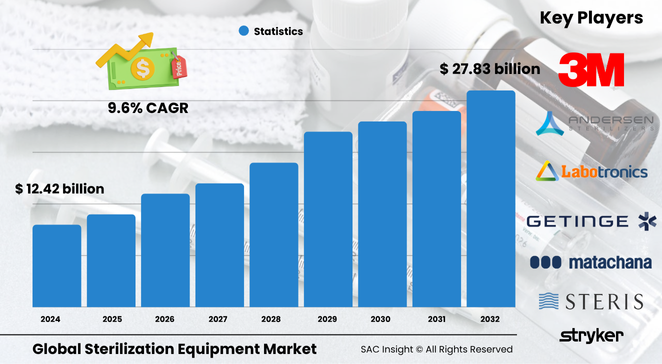
The global sterilization equipment market size is valued at roughly US$ 12.42 billion in 2024 and is projected to reach about US$ 27.83 billion by 2032, expanding at an average 9.6% CAGR. SAC Insight industry insights highlight three structural growth engines: stricter infection-control regulations, expanding procedure volumes in outpatient centers, and rapid adoption of low-temperature systems that safeguard heat-sensitive devices.
SAC Insight's deep market evaluation shows the United States sterilization equipment market alone could advance from about US$ 4.35 billion in 2024 to nearly USD$ 9.74 billion by 2032 as hospitals, labs, and contract sterilizers invest in modern, automated fleets.
Summary of Market Trends & Drivers
• Hospitals are migrating from legacy ethylene-oxide chambers to hydrogen-peroxide and nitrogen-dioxide units that cut cycle times and emissions.
• Disposable surgical kits and pre-filled syringes are multiplying, pushing demand for high-throughput terminal sterilization lines in pharma and med-tech plants.
• Outsourcing of sterilization services is rising among small device firms that lack in-house capacity, underpinning steady market growth.
Key Market Players
Industry leadership rests with a blend of diversified conglomerates and focused specialists. Firms such as STERIS, Getinge, and Fortive’s ASP command significant market share through broad portfolios spanning heat, gas-plasma, and monitoring products. Alongside them, companies like Steelco, Shinva, and MATACHANA emphasize modular, energy-efficient autoclaves, while 3M and TDK supply critical filtration and sensing components. Their competitive strategies center on smart controls, consumable ecosystems, and region-specific service hubs that shorten turnaround for healthcare clients.
Key Takeaways
• Current global market size (2024): about USD$ 12.42 billion
• Projected global market size (2032): roughly USD$ 27.83 billion at a 9.6 % CAGR
• North America holds close to 36 % market share, propelled by mandatory HAI-reduction programs
• Sterile membrane filters contribute the largest product revenue, exceeding 30 % of 2024 sales
• Heat sterilizers are the fastest-growing segment thanks to cost-effective steam autoclaves for instrument reprocessing
• Low-temperature NO2 and hydrogen-peroxide systems are reshaping market trends toward greener, material-friendly solutions
Market Dynamics
Drivers
• Rising surgical volumes, particularly minimally invasive and orthopedic procedures, require frequent reprocessing of complex instruments.
• Heightened awareness of healthcare-associated infections fuels investment in advanced sterilization monitoring and validation technologies.
• Expansion of biopharmaceutical manufacturing boosts demand for clean-room compatible filtration and radiation devices.
Restraints
• High capital cost of large autoclave installations can delay upgrades in smaller clinics.
• Material compatibility challenges with cutting-edge polymers restrict the universal adoption of certain sterilants.
Opportunities
• Emerging economies are scaling healthcare infrastructure, opening white-space for mid-capacity steam and gas units.
• Integration of IoT-enabled sensors offers predictive maintenance and real-time cycle analytics, creating value-added service revenue.
Challenges
• Regulatory scrutiny over ethylene-oxide emissions tightens operating permits and raises compliance costs.
• Supply-chain disruptions in stainless steel and specialty valves can extend delivery times for custom systems.
Regional Analysis
The North America sterilization equipment market dominates the market due to well-developed healthcare systems, rigorous sterilization standards, and an early-adopter mindset for low-temperature innovations. Europe follows with accelerated uptake in food and beverage sterilization, while Asia-Pacific registers the quickest percentage gains as biopharma and contract research facilities proliferate.
• North America – Largest revenue base; widespread disposable device use and outpatient surgery centers drive upgrades
• Europe – Rapid growth tied to stringent food-safety and MDR requirements
• Asia-Pacific – Highest CAGR as China and India build new hospitals and vaccine plants
• Latin America – Steady demand supported by public-health initiatives targeting HAIs
• Middle East & Africa – Gradual adoption as tertiary care capacity expands
Segmentation Analysis
By Product
• Sterile Membrane Filters – Market-leading share.
Membrane filters are indispensable across pharma, biotech, and beverage lines for endotoxin-free fluids, solidifying their top slot.
Their ease of integration, low per-cycle cost, and broad chemical compatibility continue to win specification in new filling suites.
• Heat Sterilizers – Fastest-growing product.
Modern steam autoclaves and dry-heat depyrogenation ovens eliminate microorganisms without chemical residues, aligning with sustainability goals.
Hospitals value their proven lethality and straightforward validation, while OEMs appreciate lower operating costs versus gas systems.
• Low-Temperature Sterilizers – Expanding niche.
Hydrogen-peroxide plasma, NO2, and ozone units cater to delicate endoscopes and polymer devices that cannot tolerate high heat.
Short cycles and low emissions make them a preferred upgrade path for busy reprocessing departments.
• Radiation Devices – Specialized demand.
Gamma and e-beam lines treat bulk, pre-packaged goods for contract sterilization firms.
Although capital intensive, they offer unmatched penetration for high-density loads and retain a loyal user base in single-use device production.
By Service
• On-site Sterilization Services – Core hospital function.
Central sterile departments rely on facility-based autoclaves and washers to maintain instrument availability.
Digital tracking and barcoding are enhancing throughput and traceability.
• Off-site Contract Sterilization – Rising outsourcing trend.
Small and virtual device manufacturers offload compliance to third-party providers with multi-modal capacity, lowering investment risk.
Regional hub expansion shortens turnaround and meets just-in-time production schedules.
By End-user
• Hospitals & Clinics – Command the lion’s share.
Continuous procedure flow mandates reliable, high-volume reprocessing cycles.
Capital budgets increasingly favor automated loading, closed-door cycles, and integrated biological indicators.
• Pharmaceutical & Biotech – High-growth vertical.
A surge in vaccine, biologic, and cell-therapy plants lifts demand for Grade-A clean-steam systems and validated sterile filtration.
Regulatory audits push adoption of 21 CFR Part 11 compliant data logging.
• Food & Beverage – Emerging adopter.
Stringent shelf-life and contamination standards propel uptake of filtration and UV-C chambers in dairy and bottled-drink operations.
Producers leverage equipment to cut preservative use and meet clean-label trends.
Industry Developments & Instances
• January 2024 – A global sterilization leader broadened its steam monitoring line with rapid-read indicators that cut release time by 70 %.
• June 2024 – A Scandinavia-based manufacturer launched a low-temperature chamber using cross-contamination barrier technology for orthopedic sets.
• December 2023 – A major acquisition of surgical instrumentation assets enhanced integration between washer-disinfectors and container systems, streamlining workflow for OR staff.
Facts & Figures
• Over 310 million surgeries are performed worldwide each year, driving constant instrument turnover.
• Disposable medical devices account for more than 40 % of contract radiation-sterilization volumes.
• Heat sterilizers can process loads at up to 11.5 % CAGR between 2025 and 2032, outpacing overall market growth.
• North American facilities operate roughly 35,000 hospital-grade autoclaves, with average replacement cycles of seven to ten years.
• IoT-enabled sterilizers can reduce unplanned downtime by up to 25 % through predictive alerts.
Analyst Review & Recommendations
Market analysis indicates a decisive shift toward versatile, eco-friendly sterilants and connected equipment that delivers actionable cycle data. Vendors that couple modular steam units with smart low-temperature lines and wrap them in preventive-maintenance subscriptions are poised to capture outsized market share. We recommend prioritizing R&D in material-compatible gases, expanding service networks in fast-growing Asia-Pacific corridors, and investing in emission-mitigation retrofits to navigate tightening regulations while sustaining long-term market growth.