Machinery and Equipment
 Pharmaceutical
 Automobile and Transportation
 Chemical & Materials
 Medical Devices
 Consumer Goods
 Semiconductor and Electronics
 Technology and Media
 Food and Beverages
 Energy and Mining
 Agriculture
 Biotechnology
 Construction
 Defense and Aeronautics
 Entertainment
 Retail
 Travel & Leisure
 Metals and Minerals
 Healthcare IT
 Oil & Gas
 Robotics & Automation
 Banking, Financial Services and Insurance (BFSI)

Key Market Insights
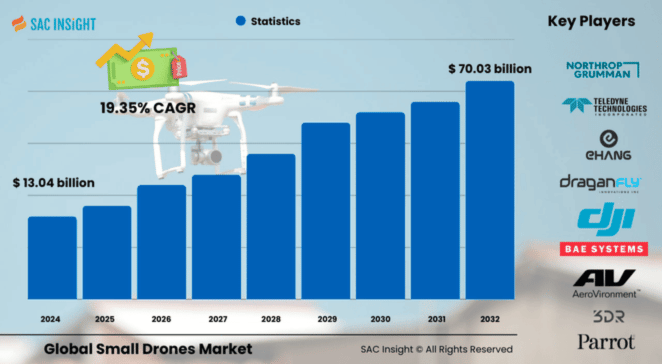
The Global small drones market size stood at US$ 13.04 billion in 2024 and is on course to hit US$ 70.3 billion by 2032, advancing at a 19.35% CAGR during the forecast period. This robust market growth rides on three structural currents: widening commercial use cases (from infrastructure inspection to cinematography), accelerating defense procurement for tactical Intelligence-Surveillance-Target-Acquisition-Reconnaissance (ISTAR), and fast-maturing battery, sensor, and autonomous-flight technologies. A SAC Insight evaluation shows that regulatory sandboxes in major economies are shortening time-to-deployment, while first-hand industry insights point to sharp price declines in rotary-wing platforms that are broadening the customer base. The U.S. small drones market is expected to reach about US$ 50.6 million by 2032, helped by Beyond-Visual-Line-of-Sight (BVLOS) waivers and rising “drone-as-first-responder” programs.
Summary of Market Trends & Drivers
• Rotary-wing platforms dominate with their vertical-take-off agility, but endurance-oriented fixed-wing units are registering the fastest uptick in agriculture, large-area mapping, and environmental monitoring.
• Swarm-intelligence trials and AI-enabled obstacle-avoidance are moving from pilot phase to early commercial rollout, tightening the link between drones and edge-analytics workflows.
• Defense and public-safety agencies are pivoting to micro-UAV fleets for cost-effective situational awareness, spurred by recent conflicts that showcased their battlefield value.
Key Market Players
Global competition of small drones market coalesces around a mix of consumer-electronics giants and aerospace specialists. SZ DJI Technology continues to set the pace in camera stabilization and turnkey flight-control software, while Parrot refocuses on ruggedized micro-UAVs for defense and industrial inspection. U.S. innovators such as AeroVironment and Skydio push the envelope in autonomous navigation, whereas Northrop Grumman and BAE Systems leverage military supply-chain depth to deliver advanced payload options. Recent market analysis indicates that smaller firms—Draganfly, DELAIR, Autel, and others—are carving out niches in first-responder kits, 4K imaging, and Europe’s evolving C-class regulatory landscape.
Key Takeaways
• Global market share for rotary-wing drones is about 60.6%, reflecting their maneuverability in tight urban and industrial spaces.
• Average CAGR 2026-2032: 19.35%.
• Projected 2032 market value: USD$ 70.3 billion.
• Military/defense retains the largest application slice at roughly 44% of 2023 revenue, but consumer and commercial segments are expanding faster.
• The AI-driven autonomous flight is the single most influential technology trend shaping future product roadmaps.
Market Dynamics
Drivers
• Expanding use of aerial data in construction, agriculture, media, and energy audits
• Rising defense budgets targeting ISR capabilities with lower risk to personnel
• Rapid improvements in lithium-silicon batteries and lightweight composite airframes
Restraints
• Privacy and air-traffic-integration concerns slowing city-center deployments
• Patchwork global regulations creating compliance complexity for cross-border operators
Opportunities
• Swarm and coordinated-flight missions for disaster response and precision agriculture
• Subscription-based “drone-as-a-service” models bundling hardware, analytics, and pilot training
Challenges
• Counter-UAS mandates forcing manufacturers to harden links against jamming and spoofing
• Supply-chain volatility in critical chips and rare-earth magnets impacting production schedules
Regional Analysis
North America holds the crown for revenue leadership, lifted by supportive FAA waivers and a dense network of enterprise adopters. Asia Pacific, however, presents the steepest growth slope as agrarian economies tap drones for yield optimization and last-mile logistics. Europe’s strict but clear regulatory framework is translating into steady corporate procurement once compliance hurdles are cleared.
• North America – Largest market share, strong defense spending and commercial BVLOS pilots
• Europe – Robust energy-infrastructure inspection demand, harmonized C-class drone rules
• Asia Pacific – Fastest CAGR, driven by precision farming and e-commerce delivery pilots
• Latin America – Early uptake in mining surveys and environmental conservation
• Middle East & Africa – Emerging interest in border monitoring and smart-city projects
Segmentation Analysis
By Type
• Rotary Wing – 60.6% share, go-to for vertical take-off, stable hover
Rotary drones thrive in confined or obstacle-rich areas, making them ideal for news gathering, roof inspections, and tactical ISR where agility trumps range.
• Fixed Wing – Fastest growth, superior range and endurance
Fixed-wing models stay aloft for hours, covering broad acreage in single sorties, a big advantage for crop-health mapping and pipeline patrols.
• Hybrid – Niche but rising, VTOL convenience plus fixed-wing endurance
Hybrid designs merge efficient cruise with rotor-assisted take-off, suiting offshore wind-farm inspections where deck space is scarce.
By Maximum Take-off Weight
• –Highest CAGR, minimal licensing barriers
Ultra-light craft appeal to hobbyists and influencers who prize portability and social-media-ready footage.
• 250 g – 2 kg – 39.2% share, sweet-spot for prosumer imaging
These platforms balance payload capacity with manageable regulatory burden, attracting surveyors and real-estate marketers.
• 2 kg – 25 kg – Preferred for industrial LiDAR and multi-spectral payloads
Greater lift supports high-power sensors and longer-range data links, critical for utility-line inspection.
• 25 kg – 150 kg – Specialized logistics and heavy-lift roles
Still nascent, but essential for drone delivery pilots that require substantial parcel weight or medical-supply drops.
By Mode of Operation
• Remotely Piloted – 76% share, familiar control, flexible missions
Human-in-the-loop remains dominant for nuanced tasks and regulatory confidence.
• Fully Autonomous – Top growth segment, AI-driven self-navigation
Onboard machine learning enables route-optimization and obstacle-avoidance without constant pilot oversight, cutting operating costs.
By Power Source
• Fuel Powered – Largest share for heavy-lift and long-range defense missions
Internal-combustion or hybrid engines extend flight time where battery swaps are impractical.
• Battery Powered – Rapidly scaling on back of lithium-tech gains
Quieter, cleaner, and favored for urban filming, inspection, and delivery pilots with quick-swap packs.
By End-use
• Defense – Prime revenue driver with ISR, target acquisition, and decoy roles
Armed forces deploy micro-UAV swarms for contested environments, reducing pilot exposure.
• Commercial – Sharpest growth in media, surveying, and energy asset inspection
Cloud-based analytics converts raw imagery into actionable insights, accelerating ROI.
• Consumer – Content-creator boom fuels demand for sub-2 kg, 4K-ready quadcopters
Social-media engagement pushes casual users toward feature-rich, app-controlled models.
• Civil & Government – Public-safety, traffic management, and environmental monitoring
Municipal agencies adopt drones for cost-effective aerial oversight of critical infrastructure and natural resources.
Industry Developments & Instances
• September 2024 – Compact APEX surveillance drone rolled out for defense and law-enforcement agencies, meeting stringent mil-spec payload and portability standards.
• September 2024 – Palm-launch 135 g drone with AI tracking and 4K video introduced, broadening ultra-light consumer segment.
• June 2024 – High-performance camera maker acquired by a leading sensor group, lining up end-to-end imaging solutions for industrial UAVs.
• March 2024 – European compliance certification attained for a flagship quadcopter series, smoothing entry into the continent’s crowded airspace.
• February 2023 – Volcano-crater inspection with thermal-zoom drone showcased rugged environmental capability for geological teams.
Facts & Figures
• Rotary-wing drones account for roughly three in every five commercial units shipped.
• Average drone battery energy density has improved about 20% since 2020, extending flight time to 45-plus minutes on flagship models.
• Swarm-intelligence flight trials cut disaster-scene mapping time by nearly 40% compared with single-drone sorties.
• Defense contracts for mini-UAVs exceeded US$ 1 billion globally in 2024, up 25% year on year.
• Sub-250 g models already represent 30% of unit sales but less than 10% of total revenue due to lower ASPs.
Analyst Review & Recommendations
Small drones are shifting from hobby gadgets to indispensable data tools. Vendors that bundle autonomous navigation, secure comms, and AI-powered analytics stand to capture the lion’s share of future market value. Scaling production of battery-powered platforms under 2 kg while simultaneously developing ruggedized, long-endurance variants for defense and energy customers offers a balanced growth path. Firms should also invest early in counter-UAS compliance features to navigate tightening security mandates and maintain customer trust.