Machinery and Equipment
  Pharmaceutical
  Automobile and Transportation
  Chemical & Materials
  Medical Devices
  Consumer Goods
  Semiconductor and Electronics
  Technology and Media
  Food and Beverages
  Energy and Mining
  Agriculture
  Biotechnology
  Construction
  Defense and Aeronautics
  Entertainment
  Retail
  Travel & Leisure
  Metals and Minerals
  Healthcare IT
  Oil & Gas
  Robotics & Automation
  Banking, Financial Services and Insurance (BFSI)
Market Overview
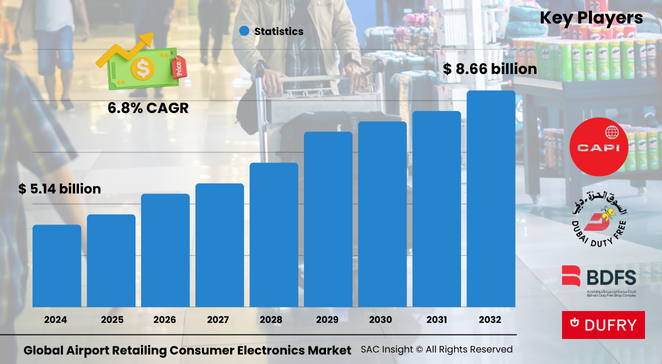
The global airport retailing consumer electronics market size is valued at roughly US$ 5.14 billion in 2024 and is projected to reach about US$ 8.66 billion by 2032, advancing at an average 6.8% CAGR during the 2025-2032 forecast window. SAC Insight's industry insights show that rising passenger traffic, widening disposable income, and a growing preference for on-the-go gadget upgrades are the dominant market growth catalysts.
SAC Insight's deep market evaluation indicates the United States airport retailing consumer electronics market alone could climb from roughly US$ 304.9 million in 2024 to around US$ 526.11 million by 2032 as airports refine duty-free layouts and embrace click-and-collect models.
Summary of Market Trends & Drivers
• Duty-free electronics zones are shifting from impulse stands to immersive showrooms that let travelers test devices, compare specs, and pay with touchless options.
• Medium and secondary hubs are diversifying revenue beyond airline fees by curating travel-friendly tech—noise-canceling headphones, power banks, smartwatches—boosting per-passenger spend.
• Hybrid retail that links e-commerce pre-order with airside pickup shortens dwell time and taps into growing online-first buying habits.
Key Market Players
Leading operators such as Crystal Media, InMotion, Dubai Duty-Free, Gebr. Heinemann, Lagardere Travel Retail, and China Duty-Free Group command significant market share through prime terminal locations, exclusive brand tie-ups, and rapid product-turnover strategies. Their competitive edge lies in blending premium gadget assortments with frictionless payment, localisation of accessory bundles, and data-driven merchandising that targets high-yield passenger segments.
Specialist newcomers—including Smartseller’s hybrid convenience-plus-electronics format and Regstaer Duty-Free’s focus on regional hubs—are widening the field. These firms leverage flexible store footprints and dynamic pricing engines to capture unmet demand in mid-traffic airports, heightening competitive intensity and accelerating product refresh cycles.
Key Takeaways
• Current global market size (2024): USD$ 5.14 billion
• Projected global market size (2032): USD$ 8.66 billion at a 6.8 % CAGR
• The U.S. market could top USD$ 526 million by 2032, driven by business-travel electronics upgrades
• Medium airports generate over USD$ 1.1 billion in 2024 revenue and outpace larger hubs at an 8.3 % CAGR
• Electronic devices account for approximately 36 % market share, led by smartphones, tablets, and headphones
• East Asia holds about 23.5 % market share, propelled by tech-savvy leisure travelers and expanding duty-free footprints
Market Dynamics
Drivers
• Rising global air travel volumes and longer layovers boost in-terminal retail footfall.
• Travelers value convenience and immediacy; replacing chargers or upgrading accessories in-transit fits modern lifestyles.
• Integration of mobile pre-order platforms with airside pickup reduces cart abandonment and lifts average ticket size.
Restraints
• Carry-on size limits and strict security checks deter purchases of bulkier devices.
• Price-sensitive passengers may postpone buys in favor of online deals outside airport environments.
Opportunities
• Eco-friendly gadgets and recyclable packaging can attract sustainability-minded flyers and justify premium pricing.
• Collaborations with leading tech brands for airport-exclusive SKUs drive differentiation and higher margins.
Challenges
• Exchange-rate volatility impacts perceived value of duty-free electronics.
• Supply-chain disruptions for key components (chips, batteries) can lead to out-of-stock situations and missed sales.
Regional Analysis
North America dominates revenue thanks to dense flight frequencies, high average income, and a culture of frequent device upgrades. East Asia follows closely, benefiting from gadget-oriented consumer behaviour and aggressive airport expansion programs. Europe leverages luxury positioning and strong intra-EU travel flows, while the Middle East capitalises on mega-hubs that pitch duty-free electronics as part of a broader premium travel experience.
• North America – Strongest revenue base, powered by business travel and quick-turn gadget needs
• Europe – Luxury-oriented merchandising and tech-forward airports sustain steady demand
• Asia-Pacific – Fastest percentage growth, underpinned by expanding middle-class tourism and digital-first consumers
• Latin America – Emerging growth as regional carriers add routes and airports upgrade retail space
• Middle East & Africa – Hub-and-spoke traffic funnels high-spend passengers through large-format duty-free stores
Segmentation Analysis
By Product Type
• Electronic Devices – Core revenue driver.
High-value items such as smartphones, tablets, and noise-canceling headphones dominate purchase intent, especially among frequent flyers needing performance upgrades before long-haul flights.
These premium devices command the largest ticket sizes, making them vital for hitting revenue targets despite lower unit volumes.
• Accessories – Volume engine.
Power banks, charging cables, and travel adapters sell briskly as last-minute essentials, driving steady turnover and impulse buys.
Their lower price points encourage multi-item baskets, cushioning sales in periods of softer big-device demand.
• Others – Niche smart gadgets.
Wearables, mini-drones, and VR viewers attract tech enthusiasts seeking novelty gifts or duty-free exclusives.
While smaller in market share, they create buzz and encourage repeat footfall.
By Airport Size
• Medium Airports – Fastest-growing tier.
These hubs aim to offset airline-fee reliance by curating compact yet experience-rich electronics corners.
Control over merchandising and community partnerships give them flexibility to tailor assortments to regional traveler profiles.
• Large Airports – High absolute sales.
Flagship stores with expansive inventories appeal to long-haul and luxury segments.
Integrated marketing campaigns and high-traffic gate locations assure consistent footfall.
• Small Airports – Opportunistic.
Pop-up kiosks and vending-machine electronics meet essential needs where space is limited.
Growth hinges on seasonal traffic spikes and charter operations.
By Sales Channel
• Duty-Free Shops – Price advantage anchor.
Tax-free pricing remains a primary pull, especially for premium headphones and flagship smartphones.
Strategic placement after security maximises dwell time and browsing.
• Specialty Retail Stores – Experience centres.
Hands-on demos, multilingual staff, and accessory bundling drive up-sell opportunities and customer loyalty.
These outlets often pilot new retail technologies such as AR product visualization.
• Online Pre-Order & Click-and-Collect – Rising convenience play.
Mobile-first passengers secure inventory and promotions before arrival, then collect airside.
This omni-channel approach trims queue times and captures digitally savvy shoppers who might otherwise bypass physical stores.
By Customer Type
• Business Travelers – High-margin segment.
They prioritise reliable laptops and audio devices for productivity, often expensing purchases.
Store layouts featuring quick-grab power accessories cater directly to their tight schedules.
• Leisure Travelers – Value seekers.
Vacationers hunt for special offers and souvenir gadgets, boosting accessory sales and limited-edition device uptake.
Family travel drives demand for tablets and portable gaming consoles.
• Frequent Flyers – Innovation adopters.
Elite passengers look for the newest wearables and smart-luggage trackers, underpinning repeat high-value transactions.
Loyalty-program integration enhances retention and upsell potential.
By Price Range
• Budget – Essential replacements.
Basic chargers and entry-level earbuds address emergency needs without straining wallets.
High turnover offsets lower margins.
• Mid-Range – Balanced performance.
Mainstream smartphones and branded headphones offer quality upgrades at moderate prices, appealing to broad demographics.
This tier captures the bulk of incremental revenue growth.
• Premium – Brand-led desirability.
Flagship phones, high-fidelity audio, and luxury smartwatches cater to affluent travelers and gift buyers.
Limited editions and airport-only bundles support premium positioning and margin expansion.
Industry Developments & Instances
• May 2025 – Smartseller extended its hybrid retail concept into two additional European regional hubs, blending grab-and-go F&B with curated electronics.
• February 2025 – A leading duty-free operator renewed a multiyear concession at a major U.K. airport, adding interactive demo zones for wearables.
• September 2024 – A Middle Eastern mega-hub introduced a mobile pre-order platform that links online catalogues with real-time stock visibility and gate-side pickup.
• May 2024 – InMotion partnered with a global audio brand to launch airport-exclusive limited-edition headphones, generating double-digit sales uplifts in launch month.
Facts & Figures
• East Asia captures roughly 23.5 % of current market share.
• Medium airports generated about USD$ 1.14 billion in electronics sales in 2024.
• Electronic devices segment is valued near USD$ 747.5 million in 2024 and could exceed USD$ 1.61 billion by 2032.
• Average passenger spends 7-10 minutes browsing electronics stores during layovers longer than 90 minutes.
• Touchless payment adoption in U.S. airport electronics outlets surpassed 65 % in 2024, cutting checkout times by up to 30 %.
Analyst Review & Recommendations
Airport electronics retail sits at the intersection of convenience and experience. Operators that fuse omni-channel pre-order, immersive in-store demos, and agile inventory management are best placed to outpace average market growth. We recommend prioritising medium-hub expansion, forging exclusive product launches with top tech brands, and deploying data analytics to tailor accessory bundles to flight profiles. Proactive supply-chain partnerships for fast-moving items—chargers, headphones, power banks—will mitigate stock-out risk and sustain momentum through 2032.