Machinery and Equipment
  Pharmaceutical
  Automobile and Transportation
  Chemical & Materials
  Medical Devices
  Consumer Goods
  Semiconductor and Electronics
  Technology and Media
  Food and Beverages
  Energy and Mining
  Agriculture
  Biotechnology
  Construction
  Defense and Aeronautics
  Entertainment
  Retail
  Travel & Leisure
  Metals and Minerals
  Healthcare IT
  Oil & Gas
  Robotics & Automation
  Banking, Financial Services and Insurance (BFSI)
Market Overview
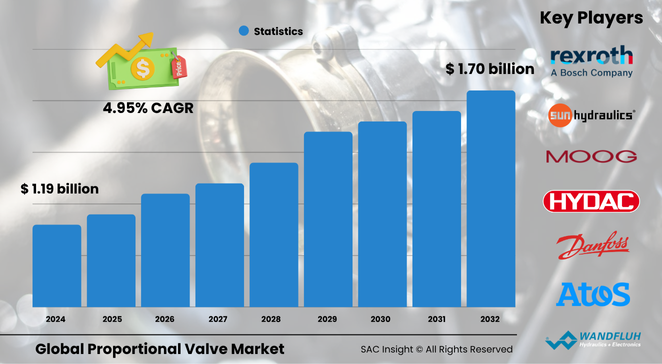
The global proportional valve market size is valued at about US$ 1.19 billion in 2024 and is projected to reach roughly US$ 1.70 billion by 2032, advancing at an average 4.95% CAGR through the 2025-2032 forecast window. First-hand industry insights highlight three structural growth engines: rising automation intensity across discrete and process industries, persistent demand for compact medical dosing systems, and renewed investment in energy-efficient hydraulic and pneumatic platforms. SAC Insight's deep market evaluation shows the United States proportional valve market alone could approach US$ 0.45 billion by 2032 as modernized factories and life-science cleanrooms upgrade to closed-loop flow-control architectures.
Summary of Market Trends & Drivers
• Manufacturers are replacing on/off valves with proportionally controlled units to trim cycle times, cut energy losses, and meet stricter emissions goals.
• Smart, IO-Link-enabled proportional valves are gaining traction, feeding plant-wide data lakes that support predictive maintenance and quality tracking.
• Miniaturization in diagnostic devices and portable ventilators is spurring demand for low-power micro-proportional valves that deliver sub-milliliter precision.
Key Market Players
Global proportional valve market share is shaped by a mix of diversified motion-control leaders and specialist valve makers. Companies such as Emerson, Parker Hannifin, Eaton, Bosch Rexroth, Burkert, and SMC leverage broad fluid-power portfolios and global service networks, underpinning customer confidence. Niche innovators—including Kendrion, HAWE Hydraulik, Moog, and Magnet-Schultz—differentiate through high-response spool designs, low-leakage seat valves, and application-specific actuator packages. Competitive dynamics increasingly revolve around digital feedback integration, modular manifolds, and region-specific certification (FDA, CE, K-type oxygen compatibility).
Key Takeaways
• Current global proportional valve market size (2024): around US$ 1.19 billion
• Projected global market size (2032): roughly US$ 1.70 billion at a 4.95% CAGR
• Europe accounts for the largest market share thanks to its advanced manufacturing base and early Industry 4.0 adoption
• Hydraulic proportional valves remain the revenue core, but electric variants post the fastest market growth in clean-room and battery-assembly lines
• Precision dosing in anesthesia and infusion pumps is a fast-growing medical niche, opening steady margins for micro-valve suppliers
• Ongoing consolidation among component makers seeks scale economies and a wider software toolkit for closed-loop control
Market Dynamics
Drivers
• Wider automation roll-outs in automotive, semiconductor, and packaging plants demand finer motion and pressure control.
• Energy-efficiency mandates in Europe and East Asia favor proportional valves that modulate flow rather than vent excess pressure.
• Aging industrial infrastructure in North America triggers retrofit programs that replace legacy solenoids with programmable units.
Restraints
• Upfront unit costs are higher than binary valves, slowing adoption in cost-sensitive segments.
• Integration complexity—valve drivers, sensors, and PLC logic—can stretch commissioning times for small OEMs.
Opportunities
• Growing hydrogen and e-fuel pilot plants need corrosion-resistant proportional valves rated for ultra-clean gases.
• Surge in telehealth equipment broadens the addressable market for silent, battery-friendly miniature valves.
Challenges
• Semiconductor shortages for power electronics can lengthen lead times and inflate BOM costs.
• Stringent medical-device approval cycles delay revenue realization for new micro-valve designs.
Regional Analysis
Europe dominates proportional valve market growth on the back of high automation density, eco-design directives, and robust vehicle electrification projects. North America follows, driven by reshoring of electronics and battery manufacturing, while Asia-Pacific posts the quickest percentage gains as China, India, and ASEAN nations scale smart-factory initiatives.
• Europe – Largest revenue base; leadership in machine tools and process automation maintains demand.
• North America – Retrofit wave in brownfield plants and strong life-science capex sustain steady market analysis momentum.
• Asia-Pacific – Fastest CAGR; electric-vehicle supply chains and expanding semiconductor fabs lift orders.
• Latin America – Mining and food-processing upgrades spark niche demand for rugged hydraulic variants.
• Middle East & Africa – Oil, gas, and water-treatment projects open pockets of opportunity for explosion-proof models.
Segmentation Analysis
By Operation
• Direct-Acting – Quick response, compact footprint.
Direct-acting units move the spool directly with the solenoid, delivering millisecond reaction times suited to high-speed robotics and packaging machinery.
• Pilot-Operated – High flow capacity, energy saving.
A small pilot stage drives a larger power stage, enabling stable control of high-pressure circuits in presses, test stands, and mobile hydraulics while keeping coil power low.
• Others – Specialty reducing and flow-control valves.
Custom designs handle proportional pressure reduction or split-range flow tasks in labs, HVAC, and niche aerospace systems.
By Technology
• Hydraulic – Heavy-duty, dominant share.
Hydraulic proportional valves withstand high pressures and contaminant loads, making them indispensable in construction equipment, metal forming, and injection molding.
• Electric – Fast switching, clean-room friendly.
Stepper- or voice-coil-driven electric valves eliminate hydraulic fluid, providing precise, oil-free control for semiconductor wet benches and battery cell assembly.
• Pneumatic – Cost-effective, maintenance light.
Pneumatic variants modulate compressed-air flow in carton sealers, pick-and-place arms, and tire inflation stations where cleanliness and low force are priorities.
By Application
• Industrial Equipment – Core demand engine.
From CNC machine tools to plastic extruders, proportional valves set clamping pressure, axis speed, and cooling flow, directly influencing cycle time and product quality.
• Instrument & Meter – Precision flow metering niche.
Analytical gas chromatographs and mass-flow controllers rely on micro-valves to maintain stable baselines and rapid calibration cycles.
• Medical Equipment – High-accuracy dosing growth driver.
Portable ventilators, anesthesia machines, and infusion pumps require silent, low-current micro-valves to safeguard patient safety and extend battery life.
• Others – Automotive, aerospace, and mobile hydraulics.
Engine management, active suspension, and flight-surface actuation use proportional control to balance performance, emissions, and comfort.
Industry Developments & Instances
• April 2023 – Emerson acquired a test-and-measurement specialist, expanding motion-control and proportional-valve diagnostics offerings.
• October 2022 – A leading multinational divested its legacy climate-technology arm to focus capital on high-growth automation and valve segments.
• April 2020 – A major U.S. firm purchased an American hydro governor manufacturer, strengthening its position in renewable hydropower control systems.
• Ongoing – Multiple vendors are rolling out IO-Link-ready proportional valves, simplifying plug-and-play integration into smart manifolds.
Facts & Figures
• Europe accounts for roughly 30 % of global market revenue in 2024.
• Hydraulic proportional valves hold nearly 45 % market share, but electric variants are posting double-digit annual market growth.
• Energy-efficient pilot-operated designs can cut coil power consumption by up to 60 % compared with legacy solenoids.
• Micro-proportional valves under 10 mm diameter now deliver repeatability better than ± 1 % of setpoint.
• IO-Link adoption in new industrial valve installations exceeded 25 % in 2024, up from 15 % two years earlier.
Analyst Review & Recommendations
Market analysis indicates a steady pivot from open-loop hydraulics to sensor-rich proportional control. Suppliers that pair responsive valve mechanics with embedded diagnostics and field-bus versatility are positioned to outpace average market trends. We recommend focusing R&D on low-power coils and corrosion-resistant materials for hydrogen service, while expanding application engineering teams to help OEMs shorten commissioning times and capture untapped market share."