Machinery and Equipment
  Pharmaceutical
  Automobile and Transportation
  Chemical & Materials
  Medical Devices
  Consumer Goods
  Semiconductor and Electronics
  Technology and Media
  Food and Beverages
  Energy and Mining
  Agriculture
  Biotechnology
  Construction
  Defense and Aeronautics
  Entertainment
  Retail
  Travel & Leisure
  Metals and Minerals
  Healthcare IT
  Oil & Gas
  Robotics & Automation
  Banking, Financial Services and Insurance (BFSI)
Market Overview
The global foliar fertilizers market size stood at about US$ 2.68 billion in 2024 and is projected to reach nearly US$ 3.802 billion by 2032, expanding at a 5.04 % CAGR. First-hand industry insights reveal three pivotal forces behind this market growth: the shift toward precision farming, rising demand for high-value horticultural produce, and government programs that encourage nutrient-efficient inputs.
SAC Insight’s deep market evaluation indicates the United States foliar fertilizers market could grow from roughly US$ 400 million in 2024 to around US$ 610 million by 2032 as large-scale producers look to cut soil losses and speed nutrient uptake.
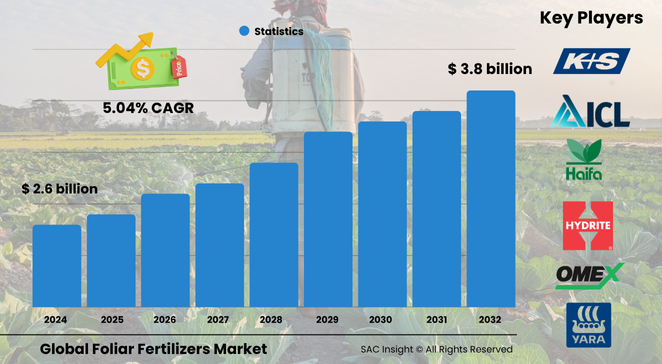
Summary of Market Trends & Drivers
• Drone-enabled spraying, GPS mapping, and real-time leaf diagnostics are turning foliar feeding into a data-driven practice rather than an emergency fix.
• Rapid uptake of biostimulant-infused formulations is reshaping product portfolios, promising higher absorption rates and improved plant resilience.
Key Market Players
Regional champions such as Coromandel International Limited and IFFCO are scaling in-house R&D and farmer-outreach programs, while global suppliers like Haifa Group leverage water-soluble expertise to deliver crop-specific spray regimes. These firms compete on formulation efficiency, field support, and distribution reach, often collaborating with ag-tech start-ups to integrate foliar programs into digital farm-management platforms.
Key Takeaways
• Current global market size (2024): USD$ 2.68 billion
• Projected global market size (2032): USD$ 3.802 billion at a 5.04 % CAGR
• Horticulture accounts for the largest market share, exceeding 40 % of revenue
• Biostimulant-based sprays are the fastest-growing product class, tracking above 7 % annual market growth
• Precision-application tools can cut fertilizer use by up to 30 % while lifting yields in micronutrient-deficient soils
Market Dynamics
Drivers
• Wider precision-farming adoption delivers targeted sprays, reducing run-off and maximizing nutrient efficiency
• Government subsidies and clean-plant programs accelerate foliar use in export-oriented fruit and vegetable chains
• Growth in protected cultivation—polyhouses and greenhouses—demands quick-acting, foliar-friendly nutrients
Restraints
• Limited awareness among smallholders and concerns over leaf scorch slow penetration in rain-fed regions
• Supply-chain fragmentation and counterfeit products erode farmer trust and margin potential
Opportunities
• Nano-scale formulations and hybrid blends open premium pricing tiers for both staple and specialty crops
• Digital crop-advisory platforms create after-sale service revenue, turning inputs into subscription bundles
Challenges
• Varied regulatory approvals across regions delay product launches and raise compliance costs
• Volatile raw-material prices pressure margins, prompting a shift toward in-country sourcing and flexible manufacturing
Regional Analysis
Asia-Pacific commands the largest market share thanks to intensive horticulture and supportive subsidy frameworks, while North America leads in precision-spray technology adoption. Europe’s demand is shaped by tight nutrient-run-off regulations, driving rapid uptake of low-salt, foliar-only programs.
• North America – High adoption of drone and sensor-guided foliar feeding in broad-acre crops
• Europe – Strict environmental rules favor low-volume, high-efficiency sprays
• Asia-Pacific – Dominant share on the back of fruit, vegetable, and cash-crop expansion
• Latin America – Robust sugarcane and citrus sectors propel biostimulant demand
• Middle East & Africa – Emerging greenhouse hubs rely on foliar feeds to manage poor soils and salinity
Segmentation Analysis
By Product
• Mineral Liquid / Suspension – Core volume driver.
These traditional formulations supply essential NPK and micronutrients in a readily available form, dominating commodity-crop programs where cost per hectare matters.
• Biostimulants – Fastest-growing niche.
Seaweed extracts, amino acids, and organic acids improve stress tolerance and nutrient uptake, finding favor with export-oriented fruit and vegetable growers who seek residue-free inputs.
• Hybrid Blends – Value-added segment.
Combining mineral nutrients with biostimulants offers a one-spray solution that boosts both yield and quality, appealing to farmers aiming to simplify spray schedules.
By Application
• Horticulture Openfield – Main demand engine.
High-value produce like grapes, citrus, and tomatoes relies on foliar sprays for quick micronutrient correction, directly influencing color, size, and shelf life.
• Horticulture Greenhouse – Precision-intensive pocket.
Controlled-environment farms favor low-volume foliar programs to fine-tune growth stages without altering substrate EC levels.
• Field Crops – Growing supplemental use.
Foliar nitrogen and micronutrient top-ups mitigate mid-season deficiencies in cereals and oilseeds, especially under erratic rainfall.
• Turf & Ornamental – Steady niche.
Golf courses and landscape managers use rapid-uptake irons and chelates to maintain uniform greening while avoiding soil accumulation.
• Others – Specialty and seed treatments.
Seed priming and late-season grain fill sprays represent emerging micro-segments with high margin potential.
Industry Developments & Instances
• October 2024 – Coromandel International opened a hi-tech polyhouse R&D farm in Telangana to accelerate foliar formulation testing under precision conditions.
• August 2024 – The Indian government launched a USD$ 210 million Clean Plant Programme aimed at modern horticulture and advanced nutrition practices.
• December 2024 – Nationwide campaign promoted Nano DAP seed and foliar treatments, targeting a 20 % cut in conventional DAP usage over five years.
• January 2025 – Haifa Group established Haifa India Fertilizers & Technologies to localize water-soluble foliar blends and fertigation programs.
Facts & Figures
• Foliar application can achieve up to 90 % nutrient uptake efficiency versus 45-60 % for soil fertilization.
• Biostimulant-infused sprays are forecast to capture nearly 30 % market share by 2032.
• Precision sprayers can reduce fertilizer volumes by 15-30 % while maintaining or increasing yields.
• Horticulture represents roughly 45 % of total foliar fertilizer consumption in 2024.
• More than 2 million hectares in India adopted foliar nutrition programs in 2024, an 18 % year-on-year increase.
Analyst Review & Recommendations
Market analysis underscores a clear pivot from corrective foliar sprays to proactive, data-guided nutrition regimes. Suppliers that integrate sensor analytics, nano-technology, and agronomic advisory into one service package will outpace average market growth. To capture this upside, prioritize field-demonstration programs that quantify yield gains, develop low-salt blends for regulated markets, and invest in scalable manufacturing that can flex with volatile raw-material costs.