Machinery and Equipment
  Pharmaceutical
  Automobile and Transportation
  Chemical & Materials
  Medical Devices
  Consumer Goods
  Semiconductor and Electronics
  Technology and Media
  Food and Beverages
  Energy and Mining
  Agriculture
  Biotechnology
  Construction
  Defense and Aeronautics
  Entertainment
  Retail
  Travel & Leisure
  Metals and Minerals
  Healthcare IT
  Oil & Gas
  Robotics & Automation
  Banking, Financial Services and Insurance (BFSI)
Market Overview
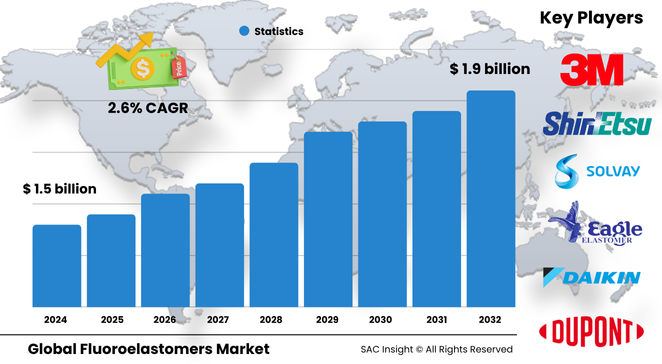
The global fluoroelastomers market size is currently valued at about US$ 1.588 billion (2024) and is on track to reach roughly US$ 1.953 billion by 2032, reflecting steady market growth at a 2.65 % CAGR. First-hand industry insights show demand is fueled by tougher emissions rules, electrified powertrains that run hotter, and a broad shift toward low-maintenance sealing solutions across automotive, aerospace, oil & gas, and chemical plants.
SAC Insight’s deep market evaluation indicates the U.S. fluoroelastomers market alone could rise from approximately US$ 508.8 million in 2024 to around US$ 625.8 million by 2032 as domestic OEMs push for lighter, more fuel-efficient designs.
Summary of Market Trends & Drivers
• Automakers are downsizing engines and integrating advanced air-management systems, raising under-hood temperatures and lifting demand for high-heat seals.
• Aerospace and oilfield operators are standardizing on FKM and FFKM compounds that withstand aggressive fuels, bio-jet blends, and corrosive drilling fluids.
• Sustainability initiatives are nudging suppliers toward non-fluorinated surfactants and bio-based modifiers without sacrificing chemical resistance.
Key Market Players
Global market share remains concentrated among a handful of specialty-polymer leaders. Companies such as Chemours, Daikin, 3M, Solvay, and AGC anchor the high-performance end of the spectrum, leveraging advanced polymer architecture and precision compounding to meet OEM specifications. Regional champions—including Gujarat Fluorochemicals, Dongyue, and Shin-Etsu—focus on cost-effective grades and local technical support, intensifying competition in Asia-Pacific.
Competitive dynamics revolve around capacity expansions, material innovation, and sustainability credentials. Recent investments in peroxide-curable lines, FDA-compliant compounds, and low-carbon manufacturing processes illustrate how producers are aligning portfolios with evolving regulatory and customer targets.
Key Takeaways
• Current global market size (2024): about USD$ 1.588 billion
• Projected global market size (2032): roughly USD$ 1.953 billion at a 2.65 % CAGR
• U.S. market expected to exceed USD$ 625 million by 2032 as EV and hybrid volumes climb
• Fluorocarbon elastomers account for the largest market share thanks to balanced cost-performance
• Seals & gaskets hold roughly 31 % of revenue; battery and powertrain upgrades are widening use cases
• Sustainability moves—non-fluorinated surfactants, energy-efficient reactors—are emerging as key market trends
Market Dynamics
Drivers
• Rising engine temperatures and aggressive biofuels heighten the need for heat- and chemical-resistant sealing solutions.
• Stricter emissions and safety standards across mobility and process industries spur material upgrades.
• Expanding renewable-energy assets require durable gaskets for high-temperature power electronics.
Restraints
• High raw-material and processing costs keep prices above conventional elastomers.
• Environmental concerns over non-biodegradable fluoropolymers attract regulatory scrutiny.
Opportunities
• Customized food- and pharma-grade compounds open premium niches with higher margins.
• Advanced mixing and precision molding unlock thinner, lighter components for EV battery packs.
Challenges
• Smaller suppliers face steep capital requirements and complex quality audits to enter OEM supply chains.
• Supply-chain volatility in fluorspar and specialty additives can disrupt production schedules.
Regional Analysis
Asia-Pacific commands the largest market share on the back of expansive automotive, electronics, and industrial bases in China, Japan, South Korea, and India. North America follows, driven by a resilient aerospace sector and rapid electrification of vehicles, while Europe benefits from stringent chemical safety regulations that favor high-performance materials.
• North America – High adoption in aerospace MRO and tight crude-oil drilling operations.
• Europe – Strong regulatory push for low-permeation fuel systems and sustainable production.
• Asia-Pacific – Fastest market growth as regional OEMs ramp up EV exports and chemical capacity.
• Latin America – Niche demand linked to refinery upgrades and deepwater exploration.
• Middle East & Africa – Gradual uptake in petrochemical and gas-processing facilities.
Segmentation Analysis
By Type
• Fluorocarbon (FKM) – Workhorse, largest revenue slice.
FKM’s balance of heat, fluid, and compression-set resistance keeps it the default choice for powertrain seals, turbocharger hoses, and fuel-system gaskets across light-vehicle and industrial platforms.
• Perfluoroelastomers (FFKM) – Premium niche, unmatched chemical tolerance.
FFKM components protect semiconductor tools, pharmaceutical reactors, and harsh-acid lines where even trace contamination or seal failure can halt production, justifying their higher cost.
By Application
• Seals & gaskets – Anchor at roughly 31 % of revenue.
Continuous downsizing of engines and the rise of high-pressure direct injection increase the number and criticality of gaskets that must remain leak-free for 200 000+ km duty cycles.
• O-rings – Fast replacement cycle, high mix.
Standardized sizes allow O-rings to serve everything from hydraulic controls to spacecraft valves, and FKM grades extend service intervals by resisting swelling in mixed-fuel environments.
• Hoses & tubings – Vital for aggressive-fluid transfer.
Fluoroelastomer linings enable lightweight, flexible fuel and coolant lines that resist permeation, a critical factor in meeting evaporative-emission limits.
• Others – Diaphragms, shaft seals, expansion joints.
Specialty parts exploiting FKM’s low compression set keep vacuum systems, chemical pumps, and metering equipment operating reliably.
By End-Use Industry
• Automotive – Chief consumer.
Powertrain electrification raises under-hood temperatures, while low-permeation mandates favor FKM in fuel vapor and battery-coolant circuits.
• Aerospace – Reliability at altitude.
FKM maintains elasticity down to –40 °C and up to 230 °C, ensuring leak-free hydraulic and fuel systems in wide-body fleets.
• Oil & gas – Harsh downhole chemistry.
Packers, bladders, and completion tools rely on FFKM for sour-gas resistance and prolonged exposure to supercritical CO2.
• Chemical processing – Corrosion defense.
Seals in reactors and transfer lines withstand concentrated acids, caustics, and solvents, cutting unplanned downtime.
• Energy & power / Pharmaceutical & food – Emerging adopters.
High-purity FKM grades satisfy FDA and EU food-contact rules, while grid-scale batteries and fuel cells need long-life gaskets.
Industry Developments & Instances
• April 2024 – Chemours introduced Advanced Polymer Architecture technology for Viton to eliminate fluorinated surfactants.
• November 2023 – Daikin unveiled a next-generation fluoroelastomer boasting improved acid resistance for semiconductor and EV battery applications.
• May 2022 – Chemours commenced sustainable Viton production using a non-fluorinated surfactant platform, lowering greenhouse-gas intensity.
• October 2019 – Solvay expanded peroxide-curable FKM capacity in Italy to serve growing automotive and oilfield demand.
• May 2017 – Asahi Glass launched AFLAS 600X, targeting high-pressure packers and gaskets.
• August 2017 – Daikin acquired Heroflon, adding specialty fluoropolymer compounding capability in Europe.
Facts & Figures
• Fluorocarbon elastomers represent roughly 58 % of total market volume.
• Average replacement interval for FKM turbo-oil seals has doubled from 120 000 km to 240 000 km over the past decade.
• Electric-vehicle battery packs can contain more than 20 % additional FKM content versus internal-combustion vehicles due to thermal-management needs.
• Advanced mixing lines cut scrap rates by up to 15 %, improving overall equipment efficiency.
• U.S. aerospace MRO consumes nearly 2 000 tons of FKM annually for hydraulic-system overhauls.
Analyst Review & Recommendations
Our market analysis highlights a clear pivot toward high-performance, sustainable formulations that align with stricter emissions targets and longer product lifecycles. Producers that combine non-fluorinated processing aids, precision compounding, and rapid prototyping services will capture outsized market share. End users should lock in multi-year supply agreements to hedge raw-material volatility and collaborate closely with material scientists to tailor compounds for next-generation EV, hydrogen, and semiconductor applications.