Machinery and Equipment
  Pharmaceutical
  Automobile and Transportation
  Chemical & Materials
  Medical Devices
  Consumer Goods
  Semiconductor and Electronics
  Technology and Media
  Food and Beverages
  Energy and Mining
  Agriculture
  Biotechnology
  Construction
  Defense and Aeronautics
  Entertainment
  Retail
  Travel & Leisure
  Metals and Minerals
  Healthcare IT
  Oil & Gas
  Robotics & Automation
  Banking, Financial Services and Insurance (BFSI)
Market Overview
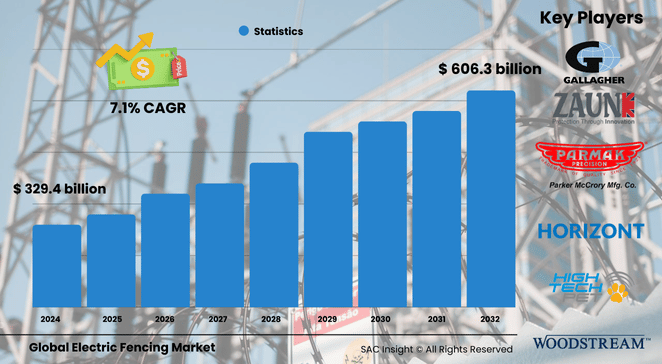
The global electric fencing market size was valued at approximately US$ 329.4 million in 2024 and is set to climb to nearly US$ 606.3 million by 2032, advancing at a 7.1% CAGR over 2025-2032. First-hand industry insights point to three structural tailwinds: persistent border-security spending, farm-level demand for crop protection, and rapid uptake of solar-powered, IoT-enabled fence energizers.
SAC Insight's deep market evaluation also shows a solid rebound from pandemic-era installation pauses, with shipment volumes already exceeding pre-2020 levels. The U.S. electric fencing market alone is projected to reach about US$ 283.3 million by 2032, supported by stronger perimeter-security budgets and an ongoing push to reduce human patrol costs.
Summary of Market Trends & Drivers
• Solar and battery storage packages are transforming remote deployments, cutting dependence on grid infrastructure while shrinking operating costs.
• IoT-ready energizers that deliver real-time voltage readings and tamper alerts are gaining traction in warehouses and logistics hubs, adding a digital layer to legacy perimeter systems.
• Military and homeland-security agencies are expanding permanent electrified barriers along contested borders, underpinning steady market growth.
Key Market Players
The landscape features a mix of long-established perimeter specialists and niche innovators. Major names such as Gallagher, Woodstream, PetSafe, and Tru-Test supply broad product ranges spanning farm kits to high-voltage border arrays. U.S.-based manufacturers continue to dominate market share through extensive distributor networks, while regional challengers in Asia-Pacific leverage lower production costs and localized service models. Across the board, players are layering cloud analytics, mobile apps, and solar modules onto traditional energizers to differentiate on technology rather than pure hardware.
Key Takeaways
• Global market value (2024): roughly US$ 329.4 million
• Projected value (2032): nearly US$ 606.3 million at a 7.1% CAGR
• North America holds about 47.7% market share, led by U.S. federal and state security programs
• Permanent fence systems command the dominant revenue slice, but portable units post the fastest unit growth
• Agriculture remains the single-largest application, yet defense and logistics facilities are closing the gap as IoT functionality matures
• Solar-powered energizers and cloud-connected alert platforms top the list of near-term purchasing priorities
Market Dynamics
Drivers
• Rising defense budgets and renewed geopolitical tensions drive continuous investment in electrified border infrastructure.
• Growing incidents of crop damage and livestock loss from wildlife push farm owners toward higher-voltage, longer-span fences.
• Falling solar-module prices widen the addressable market for off-grid installations in emerging economies.
Restraints
• High maintenance costs for large-scale permanent installations, especially across rough terrain, weigh on adoption in budget-constrained regions.
• Regulations limiting allowable fence voltage in residential zones cap uptake of more powerful systems.
Opportunities
• Smart fencing that integrates cameras, AI-based threat classification, and autonomous drones can create bundled solutions with higher margins.
• Rental-model portable fences for short-term construction and events represent an underserved revenue stream.
Challenges
• Counter-intrusion technologies such as low-cost thermal cameras and motion sensors offer competing perimeter solutions.
• Supply-chain volatility for semiconductors and steel wire can pressure production timelines and pricing.
Regional Analysis
North America retains leadership thanks to sustained homeland-security funding and large-scale ranching needs, while Asia-Pacific records the quickest expansion on the back of rising defense allocations in India and China. Europe shows steady replacement demand as aging barriers are upgraded with smart sensors.
• North America – Dominant revenue contributor; U.S.–Mexico border projects and livestock containment underpin steady demand
• Europe – Homeland-security upgrades and stricter property-protection rules fuel replacement cycles
• Asia-Pacific – Fastest growth; defense infrastructure and government-backed solar farming drive installations
• Latin America – Expanding agribusiness sector boosts portable fence uptake
• Middle East & Africa – Gradual rise tied to anti-poaching efforts and border fortification in select nations
Segmentation Analysis
By Type
• Permanent Fence – Core security backbone Permanent systems account for the bulk of market revenue due to their heavy use along national borders and large agricultural estates. Their long service life and higher voltage capacity make them the preferred choice where continuous deterrence is non-negotiable.
• Portable Fence – High-growth, flexible solution Portable fences post the highest CAGR thanks to low upfront cost, quick deployment, and easy relocation—attributes prized in seasonal farming, construction zones, and temporary crowd-control settings.
By Application
• Agriculture – Largest demand engine Farm owners rely on electric fencing to prevent wildlife incursions that can wipe out entire harvests. Increasing farmer awareness, aided by government subsidies for solar kits, keeps this segment at the front of the pack.
A well-maintained electric line delivers a mild yet memorable shock that conditions animals to stay clear, offering an economical, non-lethal safeguard for crops and livestock.
• Security – Rapidly expanding perimeter market Defense agencies and critical-asset operators are scaling permanent electrified barriers, often integrating them with radar and surveillance cameras for layered protection.
The need to detect and deter intrusions around power plants, warehouses, and data centers is nudging demand toward higher-spec energizers with remote diagnostics.
• Wild Animals – Focus on human-wildlife conflict Parks, buffer zones, and railway corridors employ solar fences to reduce dangerous encounters and protect both people and wildlife.
• Pets and Others – Steady niche growth Indoor/outdoor containment systems for dogs and specialty enclosures for zoos or research facilities add incremental volume, driven by consumer desire for unobtrusive pet boundaries.
Industry Developments & Instances
• July 2023 – A South Indian state mandated solar fences around farmland near wildlife corridors, spurring regional installation spikes.
• July 2023 – A U.S. equipment-rental firm rolled out electrified perimeter lines across its depots after a string of break-ins, citing reduced theft claims.
• March 2022 – A leading pet-care brand launched a five-acre customizable in-ground fence kit compatible with indoor avoidance transmitters, broadening its SKU mix.
Facts & Figures
• Average energizer life span: 8-10 years under routine maintenance
• IoT-enabled systems can cut manual fence-line checks by up to 40%
• Solar kits now represent roughly 30% of new units sold in regions with unreliable grid power
• A permanent high-tensile fence can deter intrusions across stretches of 20 km or more with a single energizer when properly earthed
• Voltage spikes above 7,000 V are typically sufficient to turn away large mammals without lethal force
Analyst Review & Recommendations
Electric fencing has moved from basic wire and battery setups to connected security infrastructure. Suppliers that pair robust hardware with cloud analytics, predictive maintenance alerts, and solar-ready designs will seize the lion’s share of market growth. For new entrants, portable fence rentals and integrated sensor bundles offer quick wins; established vendors should deepen aftermarket services and software subscriptions to lock in recurring revenue as the market pivots toward smarter, data-rich perimeter management.