Machinery and Equipment
  Pharmaceutical
  Automobile and Transportation
  Chemical & Materials
  Medical Devices
  Consumer Goods
  Semiconductor and Electronics
  Technology and Media
  Food and Beverages
  Energy and Mining
  Agriculture
  Biotechnology
  Construction
  Defense and Aeronautics
  Entertainment
  Retail
  Travel & Leisure
  Metals and Minerals
  Healthcare IT
  Oil & Gas
  Robotics & Automation
  Banking, Financial Services and Insurance (BFSI)
Market Overview
The global anti-pollution mask market size is valued at roughly US$ 9.71 billion in 2024 and is projected to surge to about US$ 168.36 billion by 2032, expanding at an average 38.4% CAGR. SAC Insight's first-hand industry insights highlight three structural growth engines: escalating urban air-quality concerns, sharply rising respiratory-illness prevalence, and a post-pandemic pivot toward everyday personal-protective gear.
SAC Insight’s deep market evaluation shows the United States anti-pollution mask market alone could advance from an estimated US$ 12.49 billion in 2025 to around US$ 85.50 billion by 2032 as commuters, construction workers, and fitness enthusiasts adopt high-filtration masks for routine use.
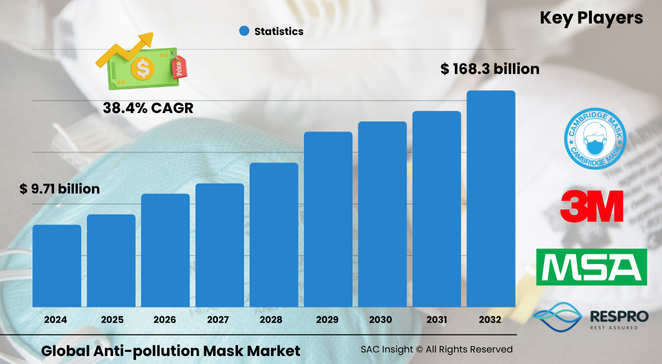
Summary of Market Trends & Drivers
• Everyday health-and-wellness routines increasingly include filtration masks, turning what was once an episodic purchase into a lifestyle accessory.
• Sustainability and cost pressure are nudging consumers toward washable multi-layer fabrics, propelling reusable models at double-digit volume growth.
Key Market Players
Industry leadership rests with a blend of diversified safety-equipment manufacturers and agile niche specialists. Long-standing incumbents such as Honeywell, 3M, and Kimberly-Clark leverage deep filtration portfolios, automated lines, and wide retail footprints to secure sizeable market share. Alongside them, brands focused on design-led comfort—Cambridge Mask, Vogmask, and Respro—differentiate through fashion collaborations, anti-fog valves, and eco-friendly materials that capture premium price points.
Competitive dynamics increasingly revolve around filter-media innovation and omnichannel reach. Large players integrate nanofiber layers and activated-carbon pellets for PM 2.5 and VOC removal, while smaller firms court online shoppers with limited-edition prints and subscription filter packs.
Key Takeaways
• Current global market size (2024): USD$ 9.71 billion
• Projected global market size (2032): USD$ 168.36 billion at a 38.4 % CAGR
• U.S. market expected to top USD$ 85.50 billion by 2032, outpacing global average growth
• Disposable masks command the largest product market share today; reusable masks post the fastest market growth on sustainability grounds
• Offline pharmacies remain the volume channel, yet online quick-commerce platforms are the highest-growth route to market
• Nanofiber filtration, smart-sensor inserts, and antimicrobial fabrics are reshaping the technology cost curve
Market Dynamics
Drivers
• Rapid urbanization and vehicle density lift particulate and NOx levels, fuelling urgent consumer demand for daily respiratory protection.
• Post-COVID hygiene awareness sustains mask adoption even outside peak flu seasons, expanding addressable user bases.
• E-commerce penetration in emerging Asia accelerates product availability, narrowing the urban–rural adoption gap.
Restraints
• Quality lapses and counterfeit products erode trust and can trigger regulatory crack-downs that slow category momentum.
• Long-term comfort issues—heat build-up, skin irritation—limit all-day wear, curbing repeat purchases in hotter climates.
Opportunities
• Smart masks with replaceable Bluetooth air-quality sensors open premium segments for health-data-driven consumers.
• Corporate wellness schemes and pollution-related employer insurance discounts can institutionalize bulk procurement.
Challenges
• Volatile raw-material costs for melt-blown polypropylene squeeze margins, particularly for low-price disposable lines.
• Recycling logistics for spent filters remain underdeveloped, posing reputational risk for brands championing sustainability.
Regional Analysis
Asia-Pacific dominates today’s market thanks to persistent smog episodes in China and India, rising construction dust, and competitively priced local production. North America follows, buoyed by wildfire smoke and a fitness culture that embraces high-performance gear, while Europe’s growth is tied to stricter PM 2.5 standards and cycling-commuter adoption.
• Asia-Pacific – Largest revenue base, driven by soaring urban pollution and affordable local manufacturing
• North America – Rapid uptake linked to wildfire seasons, fitness trends, and premium reusable launches
• Europe – Growth anchored in air-quality directives and commuter cycling infrastructure
• Middle East & Africa – Dust storms and construction projects spur episodic but rising demand
• Latin America – Industrial expansion and traffic congestion open niche opportunities in major metros
Segmentation Analysis
By Product
• Disposable – Convenience-led dominance.
Single-use masks hold the biggest market share because commuters prefer quick replacement during peak smog or illness waves. They thrive in convenience stores and pharmacies where impulse purchases are common.
• Reusable – Sustainability-driven acceleration.
Reusable masks are the fastest-growing slice, aided by washable multi-layer fabrics, filter-replacement cartridges, and stylish designs that align with apparel trends. Lower lifetime cost and green credentials resonate with eco-conscious consumers.
By Distribution Channel
• Offline – Trust and instant availability.
Brick-and-mortar outlets—pharmacies, supermarkets, hardware chains—remain the primary sales channel, offering immediate product comparison and serving walk-in buyers during pollution spikes or health scares.
• Online – Highest CAGR.
E-commerce and quick-commerce platforms boost market growth by delivering broad assortments, detailed specs, and customer reviews straight to mobile users. Subscription models for replacement filters further lock in repeat revenue.
Industry Developments & Instances
• June 2024 – A global athletic-wear brand launched a co-branded reusable mask with nano-silver lining, selling out its first 100 000 units online within 48 hours.
• December 2023 – An Indian start-up unveiled a biodegradable hemp-fiber respirator targeting festival-season air pollution, winning government innovation funding.
• August 2023 – A leading safety-equipment firm retrofitted two plants with AI-based quality-inspection cameras, lifting filter yield by 15 % and shortening order lead times.
Facts & Figures
• Disposable masks captured roughly 53 % of global revenue in 2024.
• Online channels posted a year-on-year sales jump of nearly 45 % between 2023 and 2024.
• An estimated 64 million people worldwide live with COPD—a key demographic for high-filtration respirators.
• Over 1.67 million deaths in India were linked to air pollution in 2019, underscoring acute local demand.
• Smart-sensor add-ons can raise average selling price of a reusable mask by 30–40 %, widening margins for tech-oriented brands.
Analyst Review & Recommendations
Market analysis shows a decisive pivot from emergency purchases to habitual, style-driven consumption. Providers that couple high-efficiency filter media with comfort, digital health add-ons, and robust counterfeit-mitigation labeling will capture outsized market share. To secure long-term loyalty, invest in breathable fabric R&D, scalable recycling programs, and partnerships with workplace-wellness platforms—moves that align commercial success with public-health impact.