Machinery and Equipment
  Pharmaceutical
  Automobile and Transportation
  Chemical & Materials
  Medical Devices
  Consumer Goods
  Semiconductor and Electronics
  Technology and Media
  Food and Beverages
  Energy and Mining
  Agriculture
  Biotechnology
  Construction
  Defense and Aeronautics
  Entertainment
  Retail
  Travel & Leisure
  Metals and Minerals
  Healthcare IT
  Oil & Gas
  Robotics & Automation
  Banking, Financial Services and Insurance (BFSI)
Market Overview
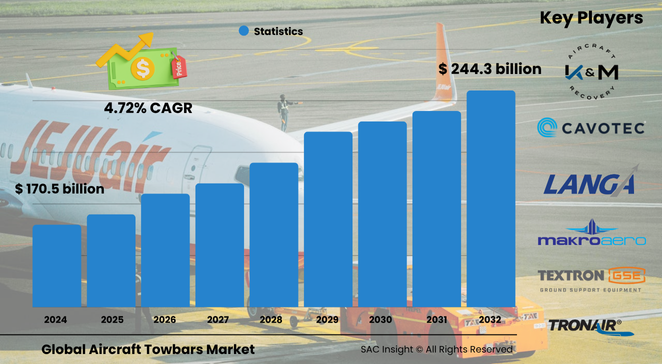
The global aircraft towbars market size is currently valued near US$ 170.58 billion in 2024 and is set to climb to roughly US$ 244.37 billion by 2032, registering around 4.72 % average CAGR through the 2025-2032 forecast window. SAC Insight's first-hand industry insights point to three clear growth engines: surging global flight activity, rapid airport infrastructure upgrades across emerging hubs, and the steady migration toward lightweight, multi-fit towbar designs that cut turn-around time.
SAC Insight's deep market analysis indicates the U.S. aircraft towbars market alone could approach US$ 50 billion by 2032 as major carriers modernize ground-support fleets to keep pace with record passenger volumes.
Summary of Market Trends & Drivers
• Airlines and ground handlers are standardizing on universal, multi-head bars to simplify mixed-fleet operations, trimming tool inventories and maintenance hours.
• Market growth is reinforced by material trends—aluminium and hybrid composites now dominate new builds, lowering weight by up to 35 % and easing ergonomic strain on ramp crews.
• Environmental targets are fuelling market trends toward electric and sensor-enabled bars that pair with tug telematics for predictive maintenance and lower on-apron emissions.
Key Market Players
Sector leadership rests with a blend of established ground-support specialists and regional engineering firms. Companies such as Tronair, Aero Specialties, Brackett Aircraft Company, AGSE Corp., K&M Airporttechnik, and Textron GSE command significant market share thanks to broad product portfolios and global service networks.
Competitive dynamics increasingly revolve around lightweight construction, smart connectivity, and sustainability credentials. European players Langa Industrial SA and Techman-Head Group, for example, are advancing remote-controlled and autonomous towbar concepts, while U.S. manufacturers emphasise rugged aluminium designs with quick-change shear pins for heavy-cycle duty.
Key Takeaways
• Current global market size (2024): about USD$ 170.58 billion
• Projected global market size (2032): roughly USD$ 244.37 billion at a 4.72 % CAGR
• Multi-head procedure type holds the largest market share due to mixed-fleet adoption by legacy and low-cost carriers
• Aluminium towbars account for more than 60 % of new unit sales thanks to superior strength-to-weight ratios
• Electric towbar mechanisms are the fastest-growing slice, expanding at double-digit annual rates as airports chase net-zero goals
• North America remains the single biggest revenue base, but Asia-Pacific shows the quickest market growth through 2032
Market Dynamics
Drivers
• Rising passenger and cargo traffic boosts aircraft movements, compelling airports to invest in high-performance towbars that safeguard tight schedules.
• Continuous fleet expansion by low-cost carriers amplifies demand for universal bars that fit everything from regional jets to narrow-body workhorses.
• Advancements in alloy metallurgy and composite inserts lower bar weight, improving operator safety and fuel savings during tug operations.
Restraints
• High purchase prices for next-generation electric or hybrid bars can deter budget-constrained regional airports.
• Raw-material price volatility, particularly aluminium, injects cost uncertainty for manufacturers and buyers alike.
Opportunities
• Digital integration with IoT-enabled tugs opens new revenue streams in predictive maintenance and usage-based leasing models.
• Emerging urban-air-mobility vertiports will require specialised light-duty bars, creating a fresh niche for innovators.
Challenges
• Strict regulatory certification adds lead-time and compliance costs, especially for newcomers.
• Supply-chain disruptions in aerospace-grade alloys can extend delivery schedules and inflate inventories.
Regional Analysis
North America commands the largest market share on the back of dense airline networks, extensive MRO activity, and early adoption of smart ground-support technology. Europe follows closely, driven by stringent safety and environmental regulations, while Asia-Pacific delivers the fastest CAGR thanks to rapid airport expansion in China, India, and Southeast Asia.
• North America – High replacement rate for ageing bars and strong shift toward electric variants
• Europe – Sustainability regulations encourage lightweight, low-emission equipment upgrades
• Asia-Pacific – New-build airports and growing low-cost carrier fleets spur robust demand
• Middle East & Africa – Hub expansion in GCC states and rising military procurement provide growth pockets
• Latin America – Gradual market growth as regional carriers modernise ground gear in step with fleet renewals
Segmentation Analysis
By Procedure Type
• Multi-Head – Fleet-wide versatility, dominant share.
Multi-head bars appeal to airlines with diverse aircraft mixes, reducing capital tied up in type-specific tools and easing training requirements for ramp crews.
• Standard/Universal – Cost-effective, reliable option.
A mainstay for single-family fleets and smaller operators, standard bars continue to sell steadily where simplicity outweighs multi-fit convenience.
By Material
• Aluminium – Lightweight leader.
Aluminium accounts for the bulk of new sales because it slashes bar mass, lowers tug drawbar load, and resists corrosion, extending service life in harsh apron environments.
• Steel – Heavy-duty niche.
Steel bars remain necessary for very high-load applications and extreme climates, despite heavier weight and higher handling effort.
By Aircraft Type
• Civil – Core demand engine.
Scheduled passenger airlines drive the majority of volume, particularly as turnaround-time metrics become central to profitability.
• Cargo – Growing secondary segment.
Rising e-commerce volumes elevate dedicated freighter fleets, lifting demand for robust bars compatible with wide-body cargo aircraft.
• Military – Stable, specification-driven share.
Air forces and defence contractors procure custom-load bars with reinforced tow-heads and enhanced shear-pin safety margins.
• Executive Jet – Premium, high-spec niche.
Business-aviation terminals prioritise compact, easy-to-stow bars that handle everything from very-light jets to ultra-long-range models.
By Tow-Head Type
• Shear Pin – Safety-first choice.
Shear-pin tow-heads deliberately fail under overload to protect aircraft landing gear, making them standard at high-traffic commercial hubs.
• Clamp – Quick-engage alternative.
Clamp designs gain popularity for regional operations where speed of attachment outweighs the slight increase in structural load risk.
By Towbar Mechanism
• Conventional – Widest installed base.
Traditional draw-bar systems dominate existing fleets, valued for mechanical simplicity and proven durability.
• Electric – Rapidly scaling, sustainability-aligned.
Battery-assisted bars integrate powered lift and steering, cutting manual effort and trimming apron emissions; rapid-charge packs now support full shift coverage.
Industry Developments & Instances
• March 2025 – A leading GSE manufacturer unveiled a carbon-composite multi-head bar 30 % lighter than previous aluminium models.
• January 2025 – A major Gulf airport placed a multi-year framework order for sensor-enabled electric bars to support its net-zero ground-operations roadmap.
• September 2024 – North American MRO provider partnered with a tech start-up to retrofit legacy bars with IoT modules for real-time stress monitoring.
• June 2024 – European regulator updated towing-equipment safety guidelines, prompting airlines to accelerate replacement of non-certified bars.
Facts & Figures
• Multi-head bars account for roughly 48 % of global sales volumes in 2024.
• Aluminium constructions reduce average bar weight from 90 kg to about 58 kg without sacrificing load capacity.
• Electric towbar mechanisms recorded a market growth rate above 12 % in 2023-2024, outpacing conventional units.
• Shear-pin failure systems cut landing-gear incident costs by up to 40 % compared with non-sacrificial designs.
• Asia-Pacific airports have added over 250 new towbar units annually since 2022, a figure projected to top 400 by 2028.
Analyst Review & Recommendations
Market analysis underscores a decisive pivot toward lighter, smarter, and greener equipment. Suppliers that blend aluminium or composite structures with plug-and-play sensor kits will outpace average market growth and capture premium pricing. Airlines and ground handlers should evaluate total-cost-of-ownership rather than headline price, prioritising multi-head compatibility, ergonomic gains, and digital maintenance insights. Given rising aluminium volatility, dual-sourcing and advance purchase agreements are advisable, while early trials of electric mechanisms can position operators ahead of tightening emissions mandates.